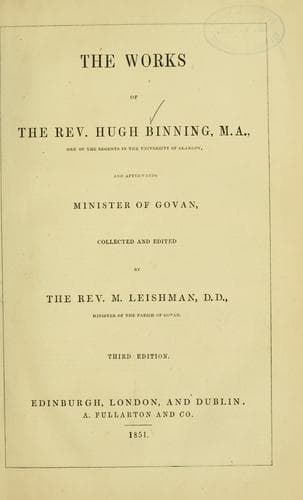
Presbyterian Church -- Sermons; Sermons, English; Theology -- Early works to 1800; Theology -- History -- 17th century
Like his friend Principal Gillespie, however, Binning appears to have kept
up an amicable intercourse with some of the Independents in the army of
the Commonwealth. He even gave the use of his church to the chaplain
attached to Colonel Overtoun’s regiment, and not only went himself to hear
him preach, but exhorted his people likewise to do so. Such conduct, on
his part, will be viewed differently by different people. It will be
condemned by those who are servilely attached to their own particular
communion, and disposed to extend the line of separation between
themselves and others, even beyond the limits prescribed by their own
canonical rules; but it will be approved of by all whose charity is not
bounded by their own narrow pale; who, when they agree with others
respecting the fundamental doctrines of religion, would grant to them, as
to smaller matters, the toleration they claim for themselves; and who,
withal, believe, that much of that asperity and jealousy which disturb the
peace, and sully the character of the Christian world, would in all
likelihood be destroyed and prevented, were they, who unhappily are
separated from one another by names and forms, to become better acquainted
with each other’s principles, and each other’s feelings. Binning was
blamed by some of his brethren for his liberality. The part he had acted
was brought under the consideration of one of the inferior church courts.
He endeavoured to justify himself, and to show that he had done nothing
inconsistent either with his Christian or his ministerial character. But
not succeeding in the attempt, with true Christian forbearance, he
expressed his desire to avoid giving offence to his brethren, and
intimated his willingness that his conduct in similar cases should
henceforward be regulated by their wishes.(16)
As a proof of the influence which, along with Cromwell, some of the
independent chaplains in his army possessed over a number of the Scottish
clergy, it has been asserted that it was owing to them that a change was
effected in some of the forms of the presbyterian mode of worship. “It is
very observable,” it has been said, “that all the presbyterian ministers
in Scotland made use of the Christian forms of the Lord’s Prayer, Creed,
and Doxology, until Oliver’s army invaded Scotland, and the independent
chaplains in that army thought their own dispensation was above that of
Geneva. Upon this, such of the presbyterians as would recommend themselves
to the Usurper, and such as had his ear, forbore those forms in the public
worship, and by degrees they fell into desuetude.”(17)
Public-domain text, read in full here on John Shaqi.
Reviews
Reviews
No reviews yet
Be the first to share your thoughts on this work.
Join the Discussion
Join the discussion
Sign in to leave a comment or review.
Sign InorCreate an account