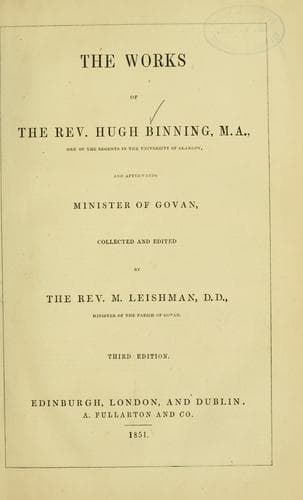
Presbyterian Church -- Sermons; Sermons, English; Theology -- Early works to 1800; Theology -- History -- 17th century
Secondly, I say to such souls, that it is the mistake of the very nature
of faith that leads them to such perplexities, and causeth such
inevidence. It is not so much the inevidence of marks and fruits that
makes them doubt, as the misapprehension of the thing itself, for as long
as they mistake it in its own nature, no sign, no mark, can satisfy in it.
You take faith to be a persuasion of God’s love that calms and quiets the
mind. Now, such a persuasion needs no signs to know it by, it is manifest
by its own presence, as light by its own brightness. It were a foolish
question to ask any, how they knew that they were persuaded of another’s
affection? The very persuasion maketh itself more certain to the soul than
any token. So then, while you question whether you have faith or not, and
in the mean time take faith to be nothing else but such a persuasion, it
is in vain to bring any marks or signs to convince you that you have
faith, for if such a persuasion and assurance were in you, it would be
more powerful to assure your hearts of itself than any thing else, and
while you are doubting of it, it is more manifest that you have it not,
than any signs or marks can be able to make it appear that you have it. If
any would labour to convince a blind man that he saw the light, and gave
him signs and tokens of the lights shining, the blind man could not
believe him, for it is more certain to himself that he sees not, that any
evidence can make the contrary probable. You are still wishing and seeking
such a faith as puts all out of question. Now, when ministers bring any
marks to prove you have true faith, it cannot satisfy or settle you,
because your very questioning proves that ye have not that which ye
question. If you had such a persuasion, you would not question it. So
then, as long as you are in that mistake concerning the true nature of
faith, all the signs of the word cannot settle you. But I say, if once you
understood the true nature of faith, it would be more clear in itself unto
you, than readily marks and signs could make it especially in the time of
temptation. If you would know, then, what it is indeed, consider what the
word of God holds out concerning himself, or us, and the solid belief of
that in the heart hath something of the nature of saving faith in it. The
Lord gives a testimony concerning man, that he is “born in sin,” that he
is “dead in sin,” and all his “imaginations are only evil continually.”
Now, I say, to receive this truth into the soul, upon God’s testimony, is
a point of faith. The Lord in his word “concludes all under sin” and
wrath, so, then, for a soul to conclude itself also under sin and wrath is
a point of faith. Faith is the soul’s testimony to God’s truth, the word
is God’s testimony. Now then, if a soul receive this testimony within,
whether it be law or gospel, it is an act of faith. If a soul condemn
itself, and judge itself, that is a setting to our seal that God is true
Public-domain text, read in full here on John Shaqi.
Reviews
Reviews
No reviews yet
Be the first to share your thoughts on this work.
Elsewhere in the archive
Join the Discussion
Join the discussion
Sign in to leave a comment or review.
Sign InorCreate an account