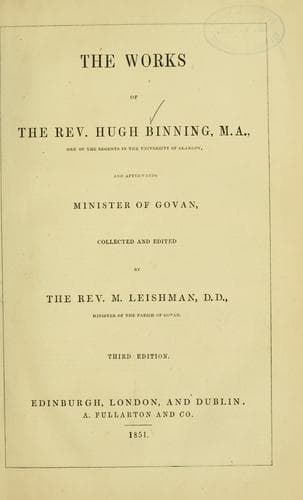
Presbyterian Church -- Sermons; Sermons, English; Theology -- Early works to 1800; Theology -- History -- 17th century
and yet none of all, _Deus est quod vides, et quod non vides_. You may
call him by all the works of his hands, for these are beams of his
uncreated light, and streams of his inexhaustible sea of goodness, so that
whatever perfection is in them, all that is eminently, yea, infinitely in
him. Therefore saith Christ, “There is one good, even God and he calls
himself ‘the light of life,’ ” and therefore you have so many names of God
in Scripture. There is no quality, no property, or virtue, that hath the
least shadow of goodness, but he is that essentially, really, eternally,
and principally, so that the creature deserves not such names but as they
participate of his fulness. He is the true light, the true life, the sun
is not that true light though it give light to the moon and to men, for it
borrows its light and shining from him. All creatures are and shine but by
reflection, therefore these names do agree to them but by a metaphor so to
speak, the propriety and truth of them is in him. As it is but a borrowed
kind of speech to call a picture or image a man—only because of the
representation and likeness to him it communicates in one name with
him—even so, in some manner, the creatures are but some shadows, pictures,
or resemblances, and equivocal shapes of God, and whatever name they have
of good, wise, strong, beautiful, true, or such like, it is borrowed
speech from God whose image they have. And yet poor vain man would be
wise,—thought wise really, intrinsically in himself, and properly,—calls
himself so; which is as great an abuse of language as if the picture
should call itself a true and living man. But then, as you may call him
all things, because he is eminently and gloriously all that is in all, the
fountain and end of all, yet we must again deny that he is any of these
things. _Unus omnia, et nihil omnium_. We can find no name to him; or what
can you call him, when you have said, “He is light?” You can form no other
notion of him but from the resemblance of this created light. But alas!
that he is not, he as infinitely transcends that, and is distant from it,
as if he had never made it according to his likeness. His name is above
all these names, but what it is himself knows, and knows only.
Public-domain text, read in full here on John Shaqi.
Reviews
Reviews
No reviews yet
Be the first to share your thoughts on this work.
Elsewhere in the archive
Join the Discussion
Join the discussion
Sign in to leave a comment or review.
Sign InorCreate an account