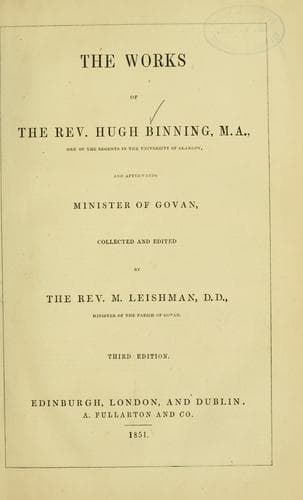
Presbyterian Church -- Sermons; Sermons, English; Theology -- Early works to 1800; Theology -- History -- 17th century
Yet they have other two wings to fly with. And being thus
composed in reverence and fear to God, they are ready to execute his
commands willingly and swiftly, Isa. vi. 1-3, &c. But what is the use
Isaiah makes of all this glorious sight? “Woe is me! I am a man of unclean
lips,” &c. Oh! all is unclean,—people, and pastor! He had known,
doubtless, something of it before, but now he sees it of new, as if he had
never seen it. The glory of God shining on him doth not puff him up in
arrogancy and conceit of the knowledge of such profound mysteries, but he
is more abased in himself by it. It shines into his heart and whole man,
and lets him see all unclean within and without. And so it was with Job,
Job xliii. 5, 6. “I have heard of thee by the hearing of the ear;” but as
long as it was hearsay, I thought myself something,—I often reflected upon
myself and actions, with a kind of self-complacency and delight; but now,
saith he, since I have seen thee by the seeing of the eye, “I abhor myself
and repent in dust and ashes;” I cannot look upon myself with
patience,—without abhorrency and detestation. Self-love made me loathe
other men’s sins more than mine own, and self-love did cover mine own sins
from me; it presented me to myself in a feigned likeness; but now I see
myself in my true shape, and all coverings stripped off. Thy light hath
pierced into my soul, and behold, I cannot endure to look upon myself.
Here now is the true knowledge of God’s majesty, which discovers within
thee a mystery of iniquity: and here is the knowledge of God indeed, which
abases all things besides God, not only in opinion but in affection, that
attracts and unites thy soul to God, and draws it from thyself and all
created things. This is a right discovery of divine purity and glory, that
spots even the cleanness of angels, and stains the pride of all glory;
much more will it represent filthiness, as filthiness without a covering.
It is knowledge and science, “falsely so called,” that puffeth up; for
true knowledge emptieth a soul of itself, and humbleth a soul in itself,
that it may be full of God. He that thinks he knows any thing, knows
nothing as he ought to know.
Public-domain text, read in full here on John Shaqi.
Reviews
Reviews
No reviews yet
Be the first to share your thoughts on this work.
Elsewhere in the archive
Join the Discussion
Join the discussion
Sign in to leave a comment or review.
Sign InorCreate an account