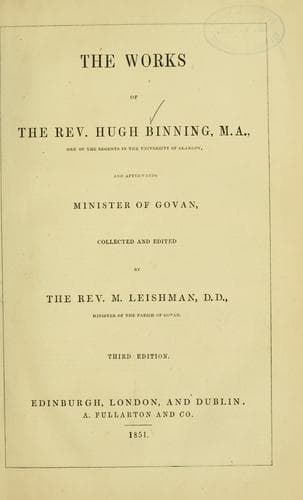
Presbyterian Church -- Sermons; Sermons, English; Theology -- Early works to 1800; Theology -- History -- 17th century
This then is the first property or mark of the saving knowledge of God. It
removes all grounds of vain confidence that a soul cannot trust unto
itself. And then the very proper intent of it is, that a soul may trust in
God, and depend on him in all things. For this purpose the Lord hath
called himself by so many names in scripture, answerable to our several
necessities and difficulties, that he might make known to us how
all-sufficient he is, that so we may turn our eyes and hearts towards him.
This was the intent of this name, I AM, that Moses might have a support of
his faith; for if he had looked to outward appearance, was it not almost a
ridiculous thing, and like a vain fancy, for a poor inconsiderable man to
go to a king with such a message, that he would dismiss so many subjects?
And was it not an attempt of some madman to go about to lead so many
thousands from a wicked tyrannical king, into another nation? Well, saith
the Lord, “I am;” I, who give all things a being, will give a being to my
promise. I will make Pharaoh hearken, and the people obey. Well then, what
is it that this name of God will not answer? It is a creating name,—a name
that can bring all things out of nothing by a word. If he be such as he
is, then he can make of us what he pleases. If our souls had this name
constantly engraven on our hearts, O what power would divine promises and
threatenings have with us! “I, even I, am he that comforteth thee,” saith
he, Isaiah xli. 12. If we believed that it were he indeed, the Lord
Jehovah, how would we be comforted! How would we praise him by his name
JAH! How would we stoop unto him, and submit unto his blessed will! If we
believed this, would we not be as dependent on him as if we had no being
in ourselves? Would we not make him our habitation and dwelling-place; and
conclude our own stability, and the stability of his church from his
unvariable eternity? as the Psalmist, Psal. xcix. 1. Psal. cii. ult. How
can we think of such a Fountain-Being, but we must withal acknowledge
ourselves to be shadows of his goodness, and that we owe to him what we
are, and so consecrate and dedicate ourselves to his glory! How can we
consider such a Self-Being, Independent, and Creating Goodness, but we
must have some desire to cleave to him, and some confidence to trust in
him! Now, this is to know him.
Public-domain text, read in full here on John Shaqi.
Reviews
Reviews
No reviews yet
Be the first to share your thoughts on this work.
Elsewhere in the archive
Join the Discussion
Join the discussion
Sign in to leave a comment or review.
Sign InorCreate an account