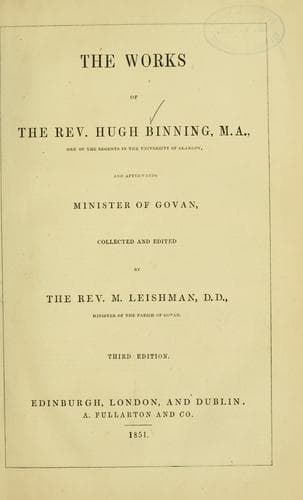
Presbyterian Church -- Sermons; Sermons, English; Theology -- Early works to 1800; Theology -- History -- 17th century
Many friends are changeable,—their
affections dry up and of themselves die, and therefore even princes’
friendship is but a vain confidence, for they shall die, and then their
thoughts of favour perish with them, but he abides the same for all
generations. There is no end of his duration and no end of his affection;
he can still say, “I am that I am. What I was, I am, and I will be what I
am.” Men cannot say so, they are like the brooks that the companies of
Teman looked after, and thought to have found them in summer as they left
them in winter, but behold they were dried up, and the companies ashamed.
God cannot make thee ashamed of thy hope, because he is faithful and able.
Ability and fidelity is a sure anchor to hold by in all storms and
tempests.
Such is God in himself. Now, there are two manner of ways he vents himself
towards the creatures,—in a comfortable way, or in a terrible way. This
glorious perfection and almighty power hath an issue upon sinners, and it
runs in a twofold channel, of mercy or justice, of mercy towards miserable
sinners that find themselves lost, and flee unto him and take hold of his
strength, and justice towards all those that flatter themselves in their
own eyes, and continue in their sins and put the evil day far off. There
is no mercy for such as fear not justice, and there is no justice for such
as flee from it unto mercy. The Lord exhibits himself in a twofold
appearance, according to the condition of sinners. He sits on a throne and
tribunal of grace and mercy, to make access to the vilest sinner who is
afraid of his wrath and would fain be at peace with him, and he sits on a
throne of justice and wrath, to seclude and debar presumptuous sinners
from holiness. There were two mountains under the law,—one of cursings,
and another of blessings. These are the mountains God sets his throne
upon, and from these he speaks and sentences mankind. From the mountain of
cursings, he hath pronounced a curse and condemnatory sentence upon all
flesh, “for all have sinned.” Therefore he concludes all under sin that
all flesh might stop their mouth, and the whole world become guilty before
God. Now, the Lord having thus condemned all mankind because of
disobedience, he sits again upon the mountain of blessings, and pronounces
a sentence of absolution, of as many as have taken with the sentence of
condemnation, and appealed to his grace and mercy, and those which do not
so, the sentence of condemnation stands above their heads unrepealed. He
erects his tribunal of justice in the world for this end, that all flesh
might once be convicted before him, and therefore he cites, as it were,
and summons all men to present themselves and appear before his tribunal,
to be judged. He lays out an accusation in the word against them. He takes
their consciences witness of the truth of all that is charged on them, and
then pronounces that sentence in their conscience, “Cursed is he that
Public-domain text, read in full here on John Shaqi.
Reviews
Reviews
No reviews yet
Be the first to share your thoughts on this work.
Elsewhere in the archive
Join the Discussion
Join the discussion
Sign in to leave a comment or review.
Sign InorCreate an account