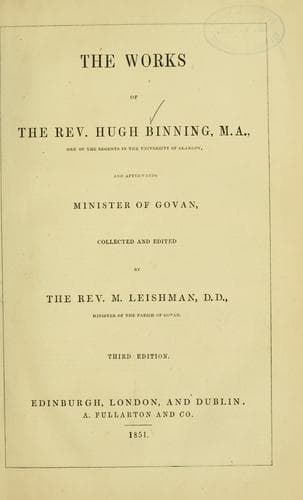
Presbyterian Church -- Sermons; Sermons, English; Theology -- Early works to 1800; Theology -- History -- 17th century
abideth not in all things,” which the conscience subsumes, and concludes
itself accursed, and subscribes to the equity of the sentence. And thus
man is guilty before God, and his mouth stopped. He hath no excuses, no
pretences, he can see no way to escape from justice, and God is justified,
by this means, in his speaking and judging. Psal. li. 4. The soul ratifies
and confirms the truth and justice of all his threatenings and judgements,
Rom. iii. 4. Now, for such souls as join with God in judging and
condemning themselves, the Lord hath erected a throne of grace and
tribunal of mercy in the word, whereupon he hath set his Son Jesus Christ,
Psal. ii. 6, lxxxix. 14, xlv. 6, Heb. i. 8. And O! this throne is a
comfortable throne. Mercy and truth go before the face of the king to
welcome and entertain miserable sinners, and to make access to them. And
from this throne Jesus Christ holds out the sceptre of the gospel, to
invite sinners, self-condemned sinners, to come to him alone, who hath
gotten all final judgment committed to him, that he may give eternal life
“to whom he will,” John v. 21, 22. O! that is a sweet and ample commission
given to our friend and brother, Jesus Christ,—power to repeal sentences
passed against us,—power and authority to absolve them whom justice hath
condemned, and to bless whom the law hath cursed, and to open their mouth
to praise whose mouth sin and guiltiness hath stopped,—power to give the
answer of a good conscience to thy evil self-tormenting conscience! In a
word, he hath power to give life, to make alive and heal those who are
killed or wounded by the commandment. Now, I say, seeing God hath of
purpose established this throne of mercy in the word, thou mayest well,
after receiving and acknowledging of the justice of the curse of the law,
appeal to divine mercy and grace sitting on another throne of the gospel.
Thou mayest—if thy conscience urge thee to despair, and to conclude there
is no hope—thou mayest, I say, appeal from thy conscience, from Satan,
from justice, unto Jesus Christ, who is holding out the sceptre to thee.
The minister calls thee, rise and come, stand no longer before that bar,
for it is a subordinate judicatory, there is a way to redress thee by a
higher court of grace. Thou mayest say to justice, to Satan, to thy own
conscience,—“It is true, I confess, that I deserve that sentence, I am
guilty, and can say nothing against it, while I stand alone. But though I
cannot satisfy, and have not; yet there is one, Jesus Christ, who gave his
life a ransom for many, and whom God hath given as a propitiation for
sins. He hath satisfied and paid the debt in my name; go and apprehend the
cautioner, since he hath undertaken it, nay, he hath done it, and is
absolved. Thou hadst him in thy hands O Justice! Thou hadst him prisoner
under the power of death. Since thou hast let him go, then he is acquitted
from all the charge of my sins; and therefore, since I know that he is now
Public-domain text, read in full here on John Shaqi.
Reviews
Reviews
No reviews yet
Be the first to share your thoughts on this work.
Elsewhere in the archive
Join the Discussion
Join the discussion
Sign in to leave a comment or review.
Sign InorCreate an account