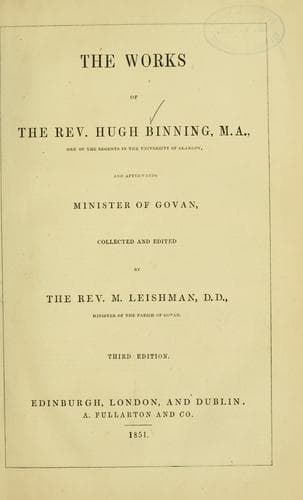
Presbyterian Church -- Sermons; Sermons, English; Theology -- Early works to 1800; Theology -- History -- 17th century
Now consider what influence all this glorious proclamation had on Moses.
It stirs up in him reverence and affection,—reverence to such a glorious
Majesty, and great desire to have him amongst them, and to be more one
with him. If thy soul rightly discover God, it cannot but abase thee. He
“made haste” to bow down and worship. O, God’s majesty is a surprising and
astonishing thing! It would bow thy soul in the dust if it were presented
to thee. Labour to keep the right and entire representation of God in thy
sight,—his whole name, strong, merciful, and just,—great, good, and holy.
I say, keep both in thy view, for half representations are dangerous,
either to beget presumption and security when thou lookest on mercy alone,
or despair when thou lookest on justice and power alone. Let thy soul
consider all jointly, that it may receive a mixed impression of all. And
this is the holy composition and temper of a believer,—Rejoice with
trembling, love with fear, let all thy discoveries of him aim at more
union and communion with him who is such a self sufficient, all
sufficient, and eternal Being.
Lecture X.
What God Is
John iv. 24.—“God is a Spirit, and they that worship him must
worship him in spirit and in truth.”
We have here something of the nature of God pointed out to us, and
something of our duty towards him. “God is a Spirit,” that is his nature,
and “man must worship him,” that is his duty, and that “in spirit and in
truth,” that is the right manner of the duty. If these three were well
pondered till they did sink into the bottom of our spirits, they would
make us indeed Christians, not in the letter, but in the spirit. That is
presupposed to all Christian worship and walking, to know what God is, it
is indeed the _primo cognitum_ of Christianity, the first principle of
true religion, the very root out of which springs and grows up walking
suitably with, and worshipping answerably of, a known God. I fear much of
our religion is like the Athenians, they built an altar to the unknown
God, and like the Samaritans, who worshipped they knew not what. Such a
worship, I know not what it is, when the God worshipped is not known. The
two parents of true religion are the knowledge of God and of ourselves.
This, indeed, is the beginning of the fear of God, which the wise preacher
calls “the beginning of true wisdom.” And these two, as they beget true
religion, so they cannot truly be one without the other. It is not many
notions and speculations about the divine nature,—it is not high and
strained conceptions of God,—that comprise the true knowledge of him. Many
think they know something when they can speak of those mysteries in some
singular way, and in some terms removed from common understandings, while
neither themselves nor others know what they mean. And thus they are
presumptuous, self conceited, knowing nothing as they ought to know. There
Public-domain text, read in full here on John Shaqi.
Reviews
Reviews
No reviews yet
Be the first to share your thoughts on this work.
Elsewhere in the archive
Join the Discussion
Join the discussion
Sign in to leave a comment or review.
Sign InorCreate an account