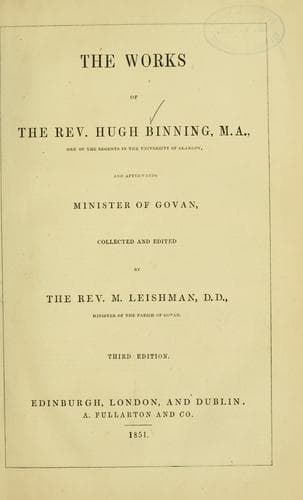
Presbyterian Church -- Sermons; Sermons, English; Theology -- Early works to 1800; Theology -- History -- 17th century
is a knowledge that puffs up and there is a knowledge that casts down, a
knowledge in many that doth but swell them, not grow them. It is but a
rumour full of wind, a vain and empty, frothy knowledge that is neither
good for edifying other, nor saving a man’s self, a knowledge that a man
knows and reflects upon so as to ascend upon the height of it, and measure
himself by the degrees of it. This is not the true knowledge of God, which
knows not itself, looks not back upon itself, but straight towards God,
his holiness and glory and our baseness and misery, and therefore it
constrains the soul to be ashamed of itself in such a glorious presence,
and to make haste to worship, as Moses, Job, and Isaiah did.
This definition of God—if we did truly understand it, we could not but
worship him in another manner. “God is a Spirit.” Many ignorant people
form in their own mind some likeness and image of God, who is invisible.
Ye know how ye fancy to yourselves some bodily shape. When you conceive of
him, you think he is some reverend and majestic person sitting on a throne
in heaven. But, I beseech you, correct your mistakes of him. There is
outward idolatry and there is inward, there is idolatry in action, when
men paint or engrave some similitude of God, and there is idolatry in
imagination, when the fancy and apprehension run upon some image or
likeness of God. The first is among Papists, but I fear the latter is too
common among us, and it is indeed all one, to form such a similitude in
our mind and to engrave or paint it without. So that the God whom many of
us worship is not the living and true God, but a painted or graven idol.
When God appeared most visible to the world, as at the giving out of the
law, yet no man did see any likeness at all. He did not come under the
perception of the most subtle sense, he could not be perceived but by the
refined understanding going aside from all things visible. And therefore
you do but fancy an idol to yourselves, instead of God, when you apprehend
him under the likeness of any visible or sensible thing, and so whatever
love or fear or reverence you have, it is all but misspent superstition,
the love and fear of an idol.
I. Know then, “that God is a Spirit,” and therefore he is like none of all
those things you see, or hear, or smell, or taste, or touch. The heavens
are glorious indeed, the light is full of glory, but he is not like that.
If all your senses should make an inquiry, and search for him throughout
the world, you should not find him. Though he be near at hand to every one
of us yet our eyes and ears and all our senses, might travel the length of
the earth and breadth of the sea, and should not find him even as you
might search all the corners of heaven ere you could hear or see an angel.
If you would saw a man asunder and resolve him into atoms of dust, yet you
could not perceive a soul within him. Why? Because these are spirits, and
so without the reach of your senses.
Public-domain text, read in full here on John Shaqi.
Reviews
Reviews
No reviews yet
Be the first to share your thoughts on this work.
Elsewhere in the archive
Join the Discussion
Join the discussion
Sign in to leave a comment or review.
Sign InorCreate an account