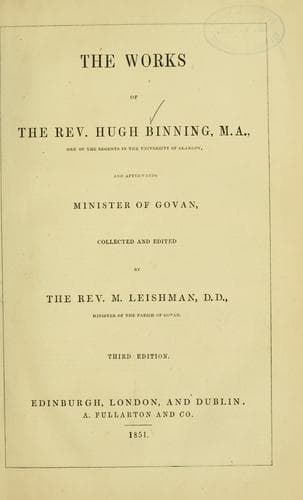
Presbyterian Church -- Sermons; Sermons, English; Theology -- Early works to 1800; Theology -- History -- 17th century
II. It seems almost certain that the manuscript must have been obtained
from the widow of the author, or from his son, both of whom were living
when the pamphlet first appeared, and both of whom were intimately
connected with the Society people. At a general meeting of the Society
people at Edinburgh, 28th May, 1683, “It was resolved that _Mr. John
Binning_ should be desired to wait upon a school, for teaching some young
men, and for his pains he was to have twenty five pounds Scots per
Quarter. According to this resolution, Mr. Binning did teach Latin to some
of these young men for some time.”(32) And in a letter from the Rev. James
Renwick, to Sir Robert Hamilton of Preston, dated Sept 26th, 1683, and
printed from the original, he says, “Likeways, according to your
direction, I challenged Mrs. Binning upon her intimacie with your sister,
but she says there is noe ground for it, and I think not such as your
honour apprehends. As also I challenged her upon the commendation she gave
Jo Wilsone, in her letter unto you, but she says she had not then seen his
testimonie, and was sorrie when she saw it, it was so contrary both to her
thoughts, and to her commendation of him.”(33) This letter is curtailed in
the printed collection of Renwick’s Letters,(34) and the passage in it,
which refers to Mrs. Binning, is only partially quoted by John Howie of
Lochgoin, in a note to Shields’ Faithful Contendings.(35)
III. A copy of the original manuscript is at present in my possession,
belonging to David Laing, Esq., Edinburgh, which, so far as one can judge
from the orthography and hand writing, must have been written near the
time of the author. It formed part of a collection of papers chiefly of
that period, of which some are docketed by Sir Archibald Johnston of
Warriston. It is entitled “The Tractat, proving that there is still a
Maligt Party, and that wee should not associate with them, written in
Januar 1651”. The writer of the Life of Binning was of opinion that as
“Mr. Binning died in the year 1653, and the pamphlet was not published
till the year 1693”, some of the Protesters would have published it, in
the course of that period, “had they known that Mr Binning was the author
of it.” But various circumstances may have occurred to prevent its being
made public at an earlier period. And although it was not printed, it may
have been read by many in manuscript. I cannot but think, though he has
mistaken the Christian name of the author, that it is to Hugh Binning’s
Case of Conscience, that Samuel Colvill, the ungodly son of a pious
mother, alludes, in that mass of ribaldry and indecency, “The Whigs
Supplication,” when describing the library of the Covenanters, he says,
“Some reads the cases of Richard Binning”(36)
This mock poem of Colvill was printed for the first time in the year 1681,
but according to the poet’s own statement, it was circulated in MS
previous to this.(37)
Public-domain text, read in full here on John Shaqi.
Reviews
Reviews
No reviews yet
Be the first to share your thoughts on this work.
Join the Discussion
Join the discussion
Sign in to leave a comment or review.
Sign InorCreate an account