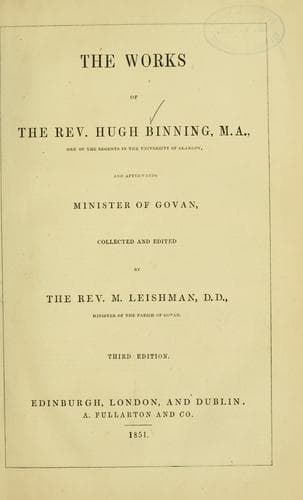
Presbyterian Church -- Sermons; Sermons, English; Theology -- Early works to 1800; Theology -- History -- 17th century
The first is the constant doctrine of the Holy Scriptures, of which ye
should consider four things: 1st, That his purpose and decree is most
wise. Therefore Paul cries out upon such a subject, “O the depth of the
riches both of the wisdom and knowledge of God!” Rom. xi. 33. His will is
always one with wisdom; therefore you have the purpose of his will
mentioned thus, “the counsel of his will;” for his will, as it were, takes
counsel and advice of wisdom, and discerns according to the depth and
riches of his knowledge and understanding. We see among men these are
separated often, and there is nothing in the world so disorderly, so
unruly and uncomely, as when will is divided from wisdom. When men follow
their own will and lusts as a law, against their conscience, that is
monstrous. The understanding and reason are the eyes of the will; if these
be put out, or if a man leave them behind him, he cannot but fall into a
pit. But the purposes of God’s will are depths of wisdom, nay, his very
will is a sufficient rule and law; so that it may be well used of him,
_Stat pro ratione voluntas_,(143) Rom. ix. 11-18. If we consider the
glorious fabric of the world,—the order established in it,—the sweet
harmony it keepeth in all its motions and successions,—O it must be a wise
mind and counsel that contrived it! Man now having the idea of this world
in his mind, might fancy and imagine many other worlds bearing some
proportion and resemblance to this. But if he had never seen nor known
this world, he could never have imagined the thousandth part of this
world; he could in nowise have formed an image in his mind of all those
different kinds of creatures. Creatures must have some example and copy to
look to; but what was his pattern? “Who hath been his counsellor” to teach
him? Rom. xi. 31. Who gave him the first rudiments or principles of that
art? Surely none. He had no pattern given him,—not the least idea of any
of these things furnished him,—but it is absolutely and solely his own
wise contrivance.—2d, This purpose of God is most free and absolute; there
is no cause, no reason, why he hath thus disposed all things, and not
otherwise, as he might have done, but his own good will and pleasure. If
it be so in a matter of deepest concernment, (Rom. ix. 18.) it must be so
also in all other things. We may find, indeed, many inferior causes,—many
peculiar reasons for such and such a way of administration,—many ends and
uses for which they serve,—for there is nothing that his majesty hath
appointed but it is for some use and reason,—yet we must rise above all
these, and ascend into the tower of his most high will and pleasure, which
is founded on a depth of wisdom; and from thence we shall behold all the
order, administration, and use of the creatures to depend. And herein is a
great difference between his majesty’s purpose and ours. You know there is
still something presented under the notion of good and convenient, that
Public-domain text, read in full here on John Shaqi.
Reviews
Reviews
No reviews yet
Be the first to share your thoughts on this work.
Elsewhere in the archive
Join the Discussion
Join the discussion
Sign in to leave a comment or review.
Sign InorCreate an account