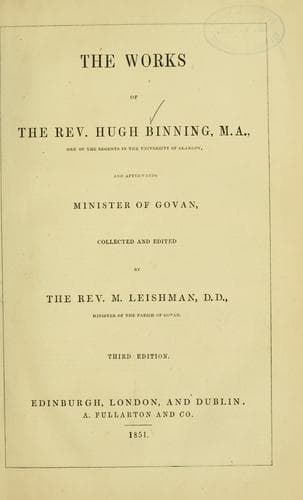
Presbyterian Church -- Sermons; Sermons, English; Theology -- Early works to 1800; Theology -- History -- 17th century
certain and necessary thing, according to the course of nature, it hath no
certainty but from his appointment, who hath established such a course in
the creatures, and which he can suspend when he pleaseth. Be it the sin of
men and devils which seems most opposite to his holiness, yet even that
cannot appear in the world of beings, if it were not, in a holy righteous,
and permissive way first conceived in the womb of his eternal counsel, and
if it were not determined by him, for holy and just ends, Acts iv. 28.
The second thing propounded is, that his mind and counsel is one, one and
the same, “yesterday, today, and forever.” Therefore the apostle speaks of
God, that there is no shadow of change or turning in him, James i. 17. He
is not a man that he should lie, neither the son of man that he should
repent; hath he said, and shall he not do it? Numb. xxiii. 19. And shall
he decree, and not execute it? Shall he purpose, and not perform it? “I am
the Lord, I change not,” that is his name, Mal. iii. 6. “The counsel of
the Lord standeth for ever, the thoughts of his heart to all generations,”
Psal. xxxiii. 11. Men change their mind oftener than their garments. Poor
vain man, even in his best estate, is changeableness, and vicissitude
itself, altogether vanity! And this ariseth partly from the imperfection
of his understanding, and his ignorance because he does not understand
what may fall out. There are many things secret and hidden, which if he
discovered, he would not be of that judgment, and many things may fall out
which may give ground of another resolution and partly from the weakness
and perverseness of his will, that cannot he constant in any good thing
and is not so closely united to it as that no fear or terror can separate
from it. But there is no such imperfection in him, neither ignorance nor
weakness. “All things are naked before him,” all their natures, their
circumstances, all events, all emergencies, known to him are they, and
“all his works from the beginning, as perfectly as in the end.” And
therefore he may come to a fixed resolution from all eternity and being
resolved he can see no reason of change because there can nothing appear
after, which he did not perfectly discover from the beginning. Therefore,
whenever ye read in the Scripture of the Lord’s repenting—as Gen. vi. 7,
Jer. xviii. 8.—ye should remember that the Lord speaks in our terms, and
like nurses with their children uses our own dialect, to point out to us
our great ignorance of his majesty, that cannot conceive more honourably
of him nor more distinctly of ourselves. When he changeth all things about
him, he is not changed, for all these changes were at once in his mind,
but when he changeth his outward dispensations he is said to repent of
what he is doing, because we use not to change our manner of dealing,
without some conceived grief, or repentance and change of mind. When a man
goes to build a house, he hath no mind but that it should continue so. He
Public-domain text, read in full here on John Shaqi.
Reviews
Reviews
No reviews yet
Be the first to share your thoughts on this work.
Elsewhere in the archive
Join the Discussion
Join the discussion
Sign in to leave a comment or review.
Sign InorCreate an account