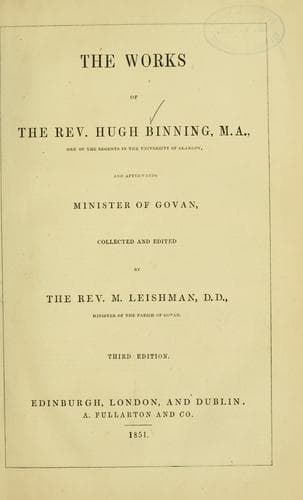
Presbyterian Church -- Sermons; Sermons, English; Theology -- Early works to 1800; Theology -- History -- 17th century
hath not the least thought of taking it down again, but afterwards it
becomes ruinous, and his estate enlarges, and then he takes a new
resolution, to cast it down to the ground and build a better. Thus it is
with man, according as he varies his work, he changes his mind. But it is
not so with God. All these changes of his works—all the successions of
times, the variation of dealings the alteration of dispensations in all
ages—were at once in his mind, and all before him, so that he never goes
to build a house but he hath in his own mind already determined all the
changes it shall be subject to. When he sets up a throne in a nation, it
is in his mind within such a period to cast it down again, when he lifts
up men in success and prosperity he doth not again change his mind when he
throws them down, for that was in his mind also so that there is no
surprisal of him by any unexpected emergence. Poor man hath many
consultations ere he come to a conclusion, but it is not thus with his
counsel. Of all those strange and new things which fall out in our days,
he hath one thought of them all from eternity. He is in one mind, and none
of all these things have put him off his eternal mind or put him to a new
advisement about his great projects. Not only doth he not change his mind,
but his mind and thought is one of all, and concerning all. Our poor,
narrow, and limited minds, must part their thoughts among many
businesses,—one thought for this, another for that, and one after another.
But with him there is neither succession of counsels and purposes, nor yet
plurality, but, as with one opening of his eye, he beholds all things as
they are, so with one inclination, or nod of his will he hath given a law,
and appointed all things.(144) If we can at one instant, and one look, see
both light and colours, and both the glass and the shadow in it and with
one motion of our wills move towards the end and the means—O, how much
more may he, with one simple undivided act of his good will and pleasure,
pass a determination on all things, in their times and orders and in his
own infinite and glorious Being perceive them all with one look! How much
consolation might redound from this to believing souls! Hath the Lord
appointed you to suffer persecution and tribulation here? Hath he carved
out such a lot unto you in this life? Then withal consider, that his
majesty hath eternal glory wrapt up in the same counsel from which thy
afflictions proceed. Hath he made thy soul to melt before him? Hath he
convinced thee, and made thee to flee unto the city for refuge, and expect
salvation from no other but himself? Then know, that life eternal is in
the bosom of that same purpose which gave thee to believe this; though the
one be born before the other, yet the decree shall certainly bring forth
the other. And for such souls as upon this vain presumption of the
infallibility of God’s purposes, think it needless to give diligence in
Public-domain text, read in full here on John Shaqi.
Reviews
Reviews
No reviews yet
Be the first to share your thoughts on this work.
Elsewhere in the archive
Join the Discussion
Join the discussion
Sign in to leave a comment or review.
Sign InorCreate an account