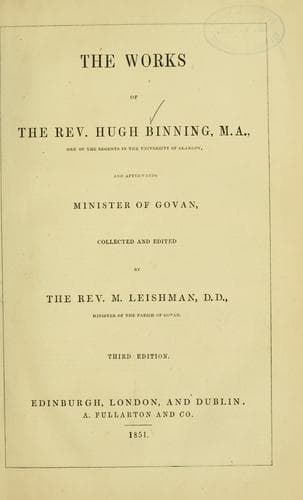
Presbyterian Church -- Sermons; Sermons, English; Theology -- Early works to 1800; Theology -- History -- 17th century
gainer by it, besides, the honour redounds to him.
Then I would exhort you, from this ground, to trust in him. Seeing he
alone is the absolute Sovereign Lord of all things,—seeing he has passed a
determination upon all things, and accordingly they must be,—and seeing
none can turn him from his way,—O then, Christians, learn to commit
yourselves to him in all things, both for this life and the life to come!
Why are ye so vain and foolish as to depend and hang upon poor, vain,
depending creatures? Why do ye not forsake yourselves? Why do ye not
forsake all other things as empty shadows? Are not all created powers,
habits, gifts, graces, strength, riches, &c., like the idols in comparison
of him, who can neither do good, neither can they do ill? Cursed is he
“that trusteth in man,” Jer. xvii. 5. There needs no other curse than the
very disappointment you shall meet withal. Consider, I beseech you, that
our God can do all things, whatever he pleases, in heaven and earth, and
that none can obstruct his pleasure. Blessed is that soul for whom the
counsel of his will is engaged. And it is engaged for all that trust in
him. He can accomplish his good pleasure in thy behalf, either without or
against means; all impediments and thorns set in his way, he can burn them
up. You who are heirs of the promises, O know your privilege! What his
soul desireth, he doth even that, and what he hath seriously promised to
you, he desires. If you ask, who are heirs of the promises? I would
answer, simply those and those only, who do own them and challenge them,
and cling to them for their life and salvation, those who seek the
inheritance only by the promise, and whose soul desires them and embraces
them. O, if you would observe how unlike ye are to God! Ye change often,
ye turn often out of the way, but that were not so ill if ye did not
imagine him to be like yourselves, and it is unbelief which makes him like
to yourselves,—when your frame and tender disposition changes,—when
presence and access to God is removed. That is wrong, it speaks out a
mortal creature indeed, but if it be so, O do no more wrong! Do not, by
your suspicions and jealousies and questionings of him, imagine that he is
like unto you and changed also. That is a double wrong and dishonour to
his majesty. Hath he not said, “I am the Lord, and change not.” “He is in
one mind, who can turn him?” How comes it then, that ye doubt of his love
as oft as ye change? When ye are in a good temper, ye think he loves you;
when it is not so ye cannot believe but he is angry, and hates you. Is not
this to speak quite contrary to the word, that he is a God that
changes—that he is not in one mind, but now in one, and then in another,
as oft as the inconstant wind of a soul’s self pleasing humour turns
about? Here is your rest and confidence, if you will be established, not
within yourselves,—not upon marks and signs within you, which ebb and flow
Public-domain text, read in full here on John Shaqi.
Reviews
Reviews
No reviews yet
Be the first to share your thoughts on this work.
Elsewhere in the archive
Join the Discussion
Join the discussion
Sign in to leave a comment or review.
Sign InorCreate an account