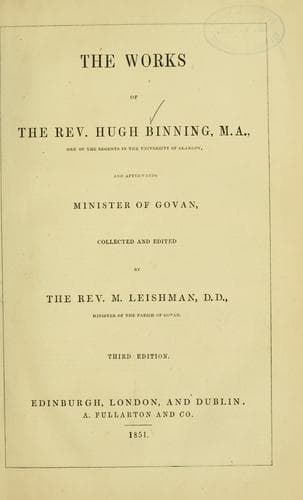
Presbyterian Church -- Sermons; Sermons, English; Theology -- Early works to 1800; Theology -- History -- 17th century
as the sea, and change as the moon,—but, upon his unchangeable nature and
faithful promises. This we desire to hold out to you all, as one ground
for all. You would every one have some particular ground in your own
disposition and condition, and think it general doctrine only which layeth
it not home so, but believe it, I know no ground of real soul
establishment, but general truths and principles common to you all, and
our business is not to lay any other foundation,—or more foundations,
according to your different conditions,—but to lay this one foundation,
Christ and God unchangeable, and to exhort every one of you to make that
general foundation your own in particular, by leaning to it, and building
upon it, and clinging to it. All other are sandy and ruinous.
Let us now, in this sad time, press consolation from this. The Lord’s hand
is in all this. It is immediate in every dispensation, and it is only
carnal mindedness that cannot see him stretching out his hand to every
man, with his own portion of affliction. Know this one thing, that God is
in one mind, for all these many ways and judgments, he is in one mind,—to
gather the saints, to build up the Church, the body of Christ. This is his
end—all other businesses are in the by,(148) and subservient to this.
Therefore he will change it as he pleases, but his great purpose of good
to his people, all the world cannot hinder. Let us then establish our
souls in this consideration, all is clear above, albeit cloudy below, all
is calm in heaven, albeit tempestuous here upon earth. There is no
confusion, no disorder in his mind. Though we think the world out of
course, and that all things reel about with confusion, he hath one mind in
it, and who can turn him? And that mind is good to them that trust in him
and therefore, who can turn away our good? Let men consult and imagine
what they please,—let them pass votes and decrees what to do with his
people,—yet it is all to no purpose, for there is a counsel above, an
older counsel which must stand and take place in all generations. If men’s
conclusions be not according to the counsel of his will, they are but
imaginary dreams, like the fancies of a distracted person, who imagining
himself a king, sits down on the throne, and gives out decrees and
ordinances. May not he who sits in heaven laugh at the foolishness and
madness of men who act in all things as if they had no dependence on him,
and go about their business as if it were not contrived already? It is a
ridiculous thing for men to order their business, and settle their own
conclusions, without once minding One above them, who hath not only a
negative, but an affirmative vote in all things. It is true that God, in
his deep wisdom, hath kept up his particular purposes secret, that men may
walk according to an appointed rule, and use all means for compassing
their intended ends, and therefore it is well said _Prudens futuri
temporis exitum caliginosa nocte premit Deus_. But yet withal we should
Public-domain text, read in full here on John Shaqi.
Reviews
Reviews
No reviews yet
Be the first to share your thoughts on this work.
Elsewhere in the archive
Join the Discussion
Join the discussion
Sign in to leave a comment or review.
Sign InorCreate an account