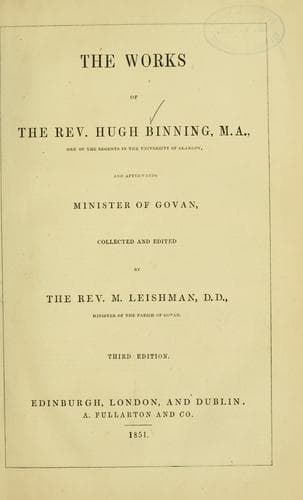
Presbyterian Church -- Sermons; Sermons, English; Theology -- Early works to 1800; Theology -- History -- 17th century
before his eyes, which he intends to effect, and which is, as it were, the
great light and sun of this firmament, unto which, by that same wonderful
counsel, all other things are subordinate, and so in the working it shall
appear exactly as his counsel did delineate and contrive it.
There is no man so empty or shallow, but he hath some great design and
purpose which he chiefly aims at; shall we not then conceive, that the
Lord, who instructs every man to this discretion, and teaches him, (Isa.
xxviii. 26,) is himself wise in his counsel, and hath some grand project
before him in all this fabric of the world, and the upholding of it since
it was made? Certainly he hath. And if you ask what it is, the wise man
will teach you in general—“He made all things for himself, yea, even the
wicked for the day of evil,” Prov. xvi. 4. Here, then, is his great design
and purpose—to glorify himself,—to manifest his own name to men and
angels. Now, his name comprehends wisdom, goodness, power, mercy, and
justice. The first three he declares in all the works of his hands. All
are well done and wisely done. The excellency of the work shows the
wonderful counsellor and the wise contriver. The goodness of any creature
in its kind, declares the inexhausted spring of a self-being from whom it
proceeds, and the bringing all these out of nothing, and upholding them,
is a glorious declaration of his power. But yet, in all the works of his
hands, there is nothing found to manifest his glorious mercy and justice,
upon which are the flower and garland of his attributes, and unto which
wisdom and power seem to be subservient. Therefore his majesty, in that
one entire purpose of his own glory, resolves to manifest his wrath and
his mercy upon men and angels, subjects capable of it, which two
attributes are as the poles about which all the wheels of election and
reprobation turn as you see in that place, Rom. ix. 22, 23. Let this then
be established as the end of all his works, as it is designed in his
counsel, and nothing else. It is not the creature, nor any thing in the
creature, which is first in his mind, but himself, and therefore of him,
and for him, are all things. Here they have their rise, and thither they
return, even to the ocean of God’s eternal glory, from whence all did
spring.
Public-domain text, read in full here on John Shaqi.
Reviews
Reviews
No reviews yet
Be the first to share your thoughts on this work.
Elsewhere in the archive
Join the Discussion
Join the discussion
Sign in to leave a comment or review.
Sign InorCreate an account