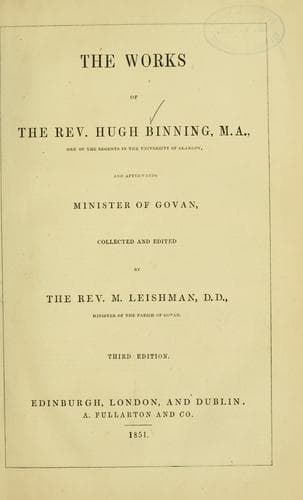
Presbyterian Church -- Sermons; Sermons, English; Theology -- Early works to 1800; Theology -- History -- 17th century
The right establishing of this will help us to conceive aright of his
counsel of predestination. It is a common cavil of carnal reason: how can
the Lord reject so many persons, and fore-ordain them to destruction? It
seems most contrary to his goodness and wisdom, to have such an end of
eternal predestination before him, in the creating of so many, to make men
for nothing, but to damn them? Here carnal reason, which is enmity to God,
triumphs, but consider, I say, that this is not the Lord’s end and chief
design, to destroy men. Even as it is not his majesty’s first look, or
furthest reach, to give unto others eternal life, so it is not his prime
intent to sink them into eternal death, as if that were his pleasure and
delight. No, indeed! Neither is the creature’s happiness nor its misery
that which first moves him, or is most desired of him, but himself only,
and he cannot move out of himself to any business, but he must return it
unto himself. Therefore the wise preacher expresses it well, “He made all
for himself, even the wicked for the day of evil.” It was not his great
end of creating wicked men to damn them, or creating righteous men to save
them, but both are for a further and higher end,—for himself and his own
glory.
All seem to agree about this, that the great end of all the Lord’s
counsels and decrees is his own glory, to be manifested on men and angels,
and that this must be first in his mind; not that there is first or last
with him, but to speak after the manner of men. If he had many thoughts,
as we have, this would be his first thought and in this one purpose this
end is chiefly aimed at, and all other things are by the Lord’s counsel
subordinate to this, as means to compass that. But as concerning the order
of these means, and consequently of his majesty’s purpose about them, men,
by examining his majesty according to the creature’s rules, or according
to sense, bring him down far below his own infinite greatness. Some
conceive that that was first, as it were, in his mind which is first done.
Looking upon the execution of his purpose in the works of his power, they
imagine, that as he first created man righteous, so this was his first
thought concerning man, to create man for the glory of his goodness and
power, without any particular determination as yet of his end. And I
conceive, this is the thought of the multitude of people. They think God
was disappointed in his work, when they hear he created such a glorious
creature that is now become so miserable. They cannot believe that his
majesty had all this sin and misery determined with him when he purposed
to create him, but look upon the emergent of man’s fall into sin and
misery as a surprisal of his majesty,—as if he had meant another thing in
creating him, and so was, upon this occasion of man’s sin, driven to a new
consultation about the helping of the business, and making the best out of
it that might be. Thus “through wisdom, the world knows not God.” They
Public-domain text, read in full here on John Shaqi.
Reviews
Reviews
No reviews yet
Be the first to share your thoughts on this work.
Elsewhere in the archive
Join the Discussion
Join the discussion
Sign in to leave a comment or review.
Sign InorCreate an account