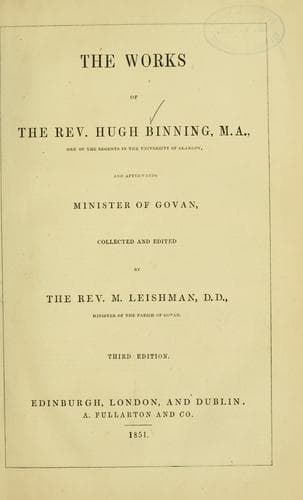
Presbyterian Church -- Sermons; Sermons, English; Theology -- Early works to 1800; Theology -- History -- 17th century
Thirdly, We have it to consider in what condition he made all these
things, “very good;” and that to declare his goodness and wisdom. The
creature may well be called a large volume, extended and spread out before
the eyes of all men, to be seen and read of all. It is certain, if these
things,—all of them in their orders and harmonies, or any of them in their
beings and qualities,—were considered in relation to God’s majesty, they
would teach and instruct both the fool and the wise man in the knowledge
of God. How many impressions hath he made in the creatures, which reflect
upon any seeing eye the very image of God! To consider of what a vast and
huge frame the heavens and the earth are, and yet but one throne to his
majesty, the footstool whereof is this earth, wherein vain men erect many
palaces; to consider what a multitude of creatures, what variety of fowls
in the heaven, and what multiplicity of beasts upon the earth, what hosts,
as Moses speaks (Gen. ii. 1,) and yet that none of them all are useless,
but all of them have some special ends and purposes they serve for, so
that there is no discord nor disorder, nor superfluity nor want in all
this monarchy of the world: all of them conspire together in such a
discord, or disagreeing harmony, to one great purpose,—to declare the
wisdom of him who “made every thing beautiful in its time,” and every
thing most fit and apposite for the use it was created for; so that the
whole earth is full of his goodness. He makes every creature good one to
another, to supply one another’s necessities; and then, notwithstanding of
so many different natures and dispositions between elements, and things
composed of them, yet all these contrarieties have such a commixion, and
are so moderated by supreme art, that they make up jointly one excellent
and sweet harmony or beautiful proportion in the world. O how wise must he
be who alone contrived it all! We can do nothing except we have some
pattern or copy before us; but now, upon this ground which God hath laid,
man may fancy many superstructures. But when he stretched out the heaven,
and laid the foundation of the earth, “who, being his counsellor, taught
him?” At whom did his Spirit take counsel? Certainly, none of all these
things would have entered into the heart of man to consider or contrive,
Isa. xl. 12, 13. Some ruder spirits do gaze upon the huge and prodigious
pieces of the creation, as whales and elephants, &c.; but a wise Solomon
will go to the school of the ant to learn the wisdom of God, and choose
out such a simple and mean creature for the object of his admiration.
Certainly, there are wonders in the smallest and most inconsiderable
creatures which faith can contemplate. O the curious ingenuity and draught
of the finger of God, in the composition of flies, bees, flowers, &c. Men
ordinarily admire more some extraordinary things; but the truth is, the
whole course of nature is one continued wonder, and that greater than any
Public-domain text, read in full here on John Shaqi.
Reviews
Reviews
No reviews yet
Be the first to share your thoughts on this work.
Elsewhere in the archive
Join the Discussion
Join the discussion
Sign in to leave a comment or review.
Sign InorCreate an account