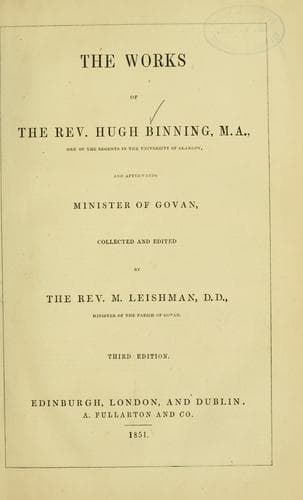
Presbyterian Church -- Sermons; Sermons, English; Theology -- Early works to 1800; Theology -- History -- 17th century
of the Lord’s works without the line. The straight and regular line of the
wisdom of God, who, in one constant course and tenor, hath ordained the
actions of all his creatures, comprehends more wonders and mysteries, as
the course of the sun, the motion of the sea, the hanging of the earth in
the empty place upon nothing. These, we say, are the wonders indeed, and
comprehend something in them which all the wonders of Egypt and the
wilderness cannot parallel. But it is the stupid security of men, that are
only awakened by some new and unusual passages of God’s works beyond that
straight line of nature.
Then, fourthly, Look upon the power of God in making all of nothing, which
is expressed here in Heb. xi. There is no artificer but he must have
matter, or his art will fail him, and he can do nothing. The mason must
have timber and stones laid to his hand, or he cannot build a house; the
goldsmith must have gold or silver ere he can make a cup or a ring. Take
the most curious and quick inventor of them all,—they must have some
matter to work upon, or their knowledge is no better than ignorance. All
that they can do is, to give some shape or form, or to fashion that in
some new model which had a being before. So that, whatever men have done
in the world, their works are all made up of those things which appear,
and art and skill to form and fashion that excellently which before was in
another mould and fashion. But he needs not sit idle for want of
materials, because he can make his materials; and therefore, in the
beginning he made heaven and earth, not as they now are, but he made first
the matter and substance of this universe, but it was as yet a rude and
confused chaos or mass, all in one lump, without difference. But then his
majesty shows his wisdom and art, his excellent invention, in the
following days of the creation, in ordering and beautifying and forming
the world as it is, and that his power might be the more known; for how
easy is it for him to do all this? There needs no more for it but a
word,—let it be, and it is. “He spake, and it was done; he commanded, and
it stood fast.” Not a word pronounced, and audibly composed of letters and
syllables—mistake it not so—but a word inwardly formed, as it were, in his
infinite Spirit. Even the inclination and beck of his will suffices for
his great work. Ye see what labour and pains we have in our business,—how
we toil and sweat about it,—what wrestlings and strivings in all things we
do; but behold what a great work is done without pain and travail? It is a
laborious thing to travel through a parcel of this earth, which is yet but
as the point of the universe; it is troublesome to lift or carry a little
piece of stone or clay; it is a toil even to look upward and number the
stars of heaven. But it was no toil, no difficult thing to his majesty, to
stretch out these heavens in such an infinite compass; for as large as the
Public-domain text, read in full here on John Shaqi.
Reviews
Reviews
No reviews yet
Be the first to share your thoughts on this work.
Elsewhere in the archive
Join the Discussion
Join the discussion
Sign in to leave a comment or review.
Sign InorCreate an account