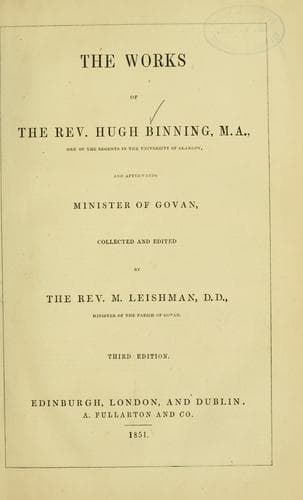
Presbyterian Church -- Sermons; Sermons, English; Theology -- Early works to 1800; Theology -- History -- 17th century
Certainly, this is the employment we were made for, to deduce all things
from God till we can again reduce all to him with glory, to bring all down
from his everlasting counsels, until we send all up to his eternal glory,
together with the sacrifice of our hearts, to behold all things to be of
him, that is, of his eternal counsel and decree.—to have their rise in the
bosom of that, and then, through him, to proceed out of the bosom of his
decree and purpose, by his power, _quasi obstetricante potentia_, and then
to return with all the promise and glory to his ever glorious name, “for
whom are all things.” There is none but they will allow God some
government in the world. Some would have him as a king, commanding and
doing all by deputies and substitutes. Some would have his influence
general, like the sun’s upon sublunary things, but how shallow are all
men’s thoughts in regard of that which is? God has prepared, indeed, his
throne in the heavens. That is true, that his glory doth manifest itself
in some strange and majestic manner above, but the whole tenor of
Scripture shows that he is not shut up in heaven, but that he immediately
cares for, governs, and disposes all things in the world, for his kingdom
is over all. It is the weakness of kings, not their glory, that they have
need of deputies, it is his glory, not baseness, to look to the meanest of
his creatures. It is a poor resemblance and empty shadow that kings have
of him, he rules in the kingdoms of men, and to him belongs the dominion
and the glory. He deserves the name of a king, whose beck heaven and earth
obey. Can a king command that the sea flow not? Can a parliament act and
ordain that the sun rise not? Or will these obey them? Yet at his decree
and command the sun is dark, the sea stands still, the mountains tremble;
“at thy rebuke the sea fled.” Alas! what do we mean that we look upon
creatures, and act ourselves as if we were independent in our being and
moving? How many things fall out and you call them casual and attribute
them to fortune? How many things do the world gaze upon, think upon, and
discourse upon, and yet not one thought, one word of God all the time?
What more contingent than the falling of a sparrow on the ground? And yet
even that is not unexpected to him, but it flows from his will and
counsel. What less taken notice of or known than the hairs of your head?
Yet these are particularly numbered by him, and so that no power in the
world can add to them or diminish from them without his counsel. O what
would the belief of this do to raise our hearts to suitable thoughts of
God above the creatures, to increase the fear, faith, and love of God, and
to abate from our fear of men, and our vain and unprofitable cares and
perplexities? How would you look upon the affairs of men,—the counsels,
contrivances, endeavours, and successes of men,—when they are turning
things upside down, and plotting the ruin of his people, and establishing
Public-domain text, read in full here on John Shaqi.
Reviews
Reviews
No reviews yet
Be the first to share your thoughts on this work.
Elsewhere in the archive
Join the Discussion
Join the discussion
Sign in to leave a comment or review.
Sign InorCreate an account