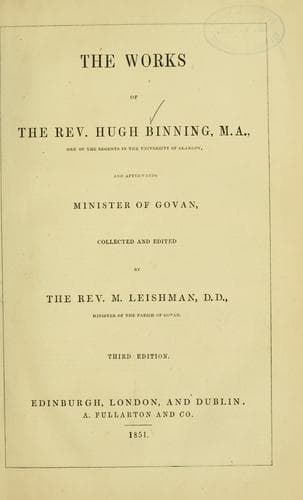
Presbyterian Church -- Sermons; Sermons, English; Theology -- Early works to 1800; Theology -- History -- 17th century
themselves alone in the earth? What would you think of all these
revolutions at this time? Many souls are astonished at them, and stand
gazing at what is done and to be done. And this is the very language of
your spirits and ways. The Lord hath forsaken the earth, the Lord seeth
not. This is the language of our parliaments and people. They do imagine
that they are doing their own business and making all sure for themselves.
But, O what would a soul think that could escape above them all, and arise
up to the first wheel of present motions! A soul that did stand upon the
exalted tower of the word of God, and looked off it by the prospect of
faith, would presently discover the circle in which all these wanderings
and changes are confined, and see men, states, armies, nations, and all of
them doing nothing but turning about in a round, as a horse in a mill,
from God’s eternal purpose, by his almighty power, to his unspeakable
glory. You might behold all these extravagant motions of the creatures,
inclosed within those limits, that they must begin here, and end here,
though themselves are so beastly that they neither know of whom nor for
whom their counsels and actions are. Certainly, Satan cannot break without
this compass, to serve his own humour. Principalities and powers cannot do
it. If they will not glorify him, he shall glorify himself by them, and
upon them.
Lecture XXI.
Of The First Covenant Made With Man
Gen. ii. 17.—“But of the tree of the knowledge of good and evil,
thou shall not eat of it, for in the day that thou eatest thereof,
thou shalt surely die.”—Gen. i. 26.—“And God said, Let us make man
in our image, after our likeness. And let them have dominion over
the fish of the sea, and over the fowl of the air, and over the
cattle, and over all the earth, and over every creeping thing that
creepeth upon the earth.”
The state wherein man was created at first, you heard was exceeding
good,—all things very good, and he best of all, the choicest external and
visible piece of God’s workmanship, made according to the most excellent
pattern,—“after our image.” Though it be a double misery to be once happy,
yet seeing the knowledge of our misery is, by the grace of God, made the
entry to a new happiness, it is most necessary to take a view of what man
once was, that we may be more sensible of what he now is. You may take up
this image and likeness in three branches.
Public-domain text, read in full here on John Shaqi.
Reviews
Reviews
No reviews yet
Be the first to share your thoughts on this work.
Elsewhere in the archive
Join the Discussion
Join the discussion
Sign in to leave a comment or review.
Sign InorCreate an account