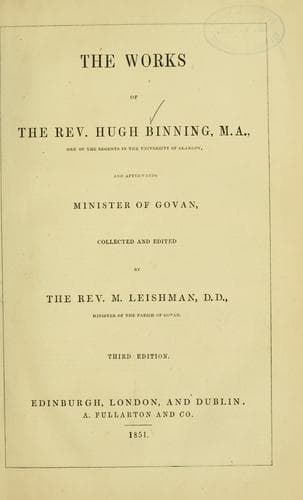
Presbyterian Church -- Sermons; Sermons, English; Theology -- Early works to 1800; Theology -- History -- 17th century
a new transaction, lays the iniquity of his elect upon Christ, and puts
the curse upon his shoulders which was due to them. Justice cannot admit
the abrogation of the law, but mercy pleads for a temperament of it. And
thus the Lord dispenses with personal satisfaction, which in rigour he
might have craved; and finds out a ransom, admits another satisfaction in
their name. And in the name of that Cautioner and Redeemer is salvation
preached upon better terms: Believe and thou shalt be saved, Rom. x. 9.
Thou lost and undone sinner, whoever thou art, that findest thyself guilty
before God, and that thou canst not stand in judgment by the former
covenant,—thou who hast no personal righteousness, and trustest in
none,—come here, embrace the righteousness of thy Cautioner,—receive him,
and rest on him, and thou shalt be saved.
Lecture XXIII.
Of The State Wherein Man Was Created, And How The Image Of God Is Defaced.
Eccl. vii. 29.—“Lo, this only have I found, that God hath made man
upright; but they have sought out many inventions.”
The one half of true religion consists in the knowledge of ourselves, the
other half in the knowledge of God; and whatever besides this men study to
know and apply their hearts unto, it is vain and impertinent, and like
meddling in other men’s matters, neglecting our own, if we do not give our
minds to the search of these. All of us must needs grant this in the
general, that it is an idle and unprofitable wandering abroad, to be
carried forth to the knowledge and use of other things, and in the mean
time to be strangers to ourselves, with whom we should be most acquainted.
If any man was diligent and earnest in the inquiry and use of the things
in the world, Solomon was. He applied his heart to seek out wisdom, and
what satisfaction was in the knowledge of all things natural; and in this
he attained a great degree beyond all other men. Yet he pronounces of it
all after experience and trial, that “this also is vanity and vexation of
spirit,”—not only empty and unprofitable, and not conducing to that true
blessedness he sought after,—but hurtful and destructive, nothing but
grief and sorrow in it. After he had proved all, with a resolution to be
wise, yet it was far from him; “I said, I will be wise, but it was far
from me,” ver. 23. And therefore, after long wandering abroad, he returns
at length home to himself, to know the estate of mankind. “Lo, this only
have I found, that God hath made man upright; but they have sought out
many inventions.” When I have searched all other things, and found many
things by search, yet, says he, what doth it all concern me, when I am
ignorant of myself? There is one thing concerns me more than all,—to know
the original of man, what he once was made, and to know how far he is
departed from his original. This only I have found profitable to men: and
as the entry and preparation to that blessedness I inquire for,—to have
Public-domain text, read in full here on John Shaqi.
Reviews
Reviews
No reviews yet
Be the first to share your thoughts on this work.
Elsewhere in the archive
Join the Discussion
Join the discussion
Sign in to leave a comment or review.
Sign InorCreate an account