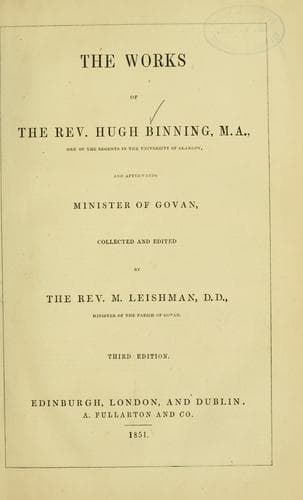
Presbyterian Church -- Sermons; Sermons, English; Theology -- Early works to 1800; Theology -- History -- 17th century
the true discovery of our misery.
There are two things, then, concerning man, that you have to search and to
know; and that not in a trifling or curious manner, as if you had no other
end in it but to know it as men do in other things, but in a serious and
earnest way, as in a matter of so much concernment to our eternal
well-being. In things that relate particularly to ourselves, we labour to
know them for some advantage besides the knowing of them, even though they
be but small and lower things; how much more should we propose this unto
ourselves in the search and examination of our own estate, not merely to
know such a thing, but so to know it that we may be stirred up and
provoked in the sense of it to look after the remedy that God holds forth.
There are two things that you have to know,—what man once was made, and
how he is now unmade; how happy once, and how miserable now. And
answerable to these two, are branches of the text: “God made man upright;”
that he was once; “and they have sought out many inventions;” not being
contented with that blessedness they were created into, by catching at a
higher estate of wisdom, have fallen down into a gulf of misery; as the
man that gazed on the stars above him, and did not take notice of the pit
under his feet till he fell into it; and thus man is now. So you have a
short account of the two estates of men; of the estate of grace and
righteousness without sin, and the estate of sin and misery without grace.
You have the true story of man from the creation unto his present
condition; but all the matter is to have the lively sense of this upon our
hearts. I had rather that we went home bewailing our loss, and lamenting
our misery, and longing for the recovery of that blessedness, than that we
went out with the exact memory of all that is spoken, and could repeat it
again.
Public-domain text, read in full here on John Shaqi.
Reviews
Reviews
No reviews yet
Be the first to share your thoughts on this work.
Elsewhere in the archive
Join the Discussion
Join the discussion
Sign in to leave a comment or review.
Sign InorCreate an account