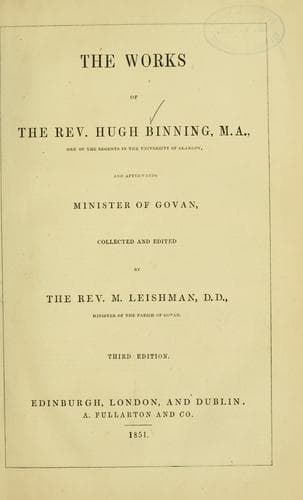
Presbyterian Church -- Sermons; Sermons, English; Theology -- Early works to 1800; Theology -- History -- 17th century
“God made man upright.” At his first moulding, the Lord showed excellent
art and wisdom, and goodness too. Man did come forth from under his hand
in the first edition very glorious, to show what he could do; upright,
that is, all right and very exactly conformed to the noble and high
pattern,—endued with divine wisdom, such as might direct him to true
happiness,—and furnished with a divine willingness to follow that
direction. The command was not above his head as a rod, but within his
heart as a natural instinct. All that was within him was comely and
beautiful; for that glorious light that shined upon him, having life and
love with it, produced a sweet harmony in the soul. He knew his duty, and
loved it, and was able to perform it. O how much is in this one word
“upright!” Not only sincerity and integrity in the soul, but perfection of
all the degrees and parts; no part of holiness wanting, and no measure of
those parts; no mixture of darkness or ignorance,—no mixture of
indisposition or unwillingness. Godliness was sweet and not laborious. The
love of God, possessing the heart, did conform all within and without to
the will of God; and O how beautiful was that conformity! And that love of
God, the fountain-being, did send forth, as a stream, love and good-will
to all things, as they did partake of God’s image; and so holiness towards
God did beget righteousness towards men, and made men to partake of one
another’s happiness.
This is a survey of him in his integrity as God made him, but there
follows a sad “but,”—a sad and woful exception,—“but they have sought many
inventions.” We cannot look upon that glorious estate whereunto man was
made, but straightway we must turn our eyes upon that misery into which he
hath plunged himself, and be the more affected with it, that it was once
otherwise. It is misery in a high degree to have been once happy. This
most of all aggravates our misery, and may increase the sense of it, that
such man once was, and such we might have been, if we had not destroyed
ourselves. Who can look upon these ruins, and refrain mourning? It is
said, that those who saw the glory of the first temple, wept when they
beheld the second, because it was not answerable to it in magnificence and
glory; so, I say, it might occasion much sadness and grief, even to the
children of God, in whom that image is in part repaired, and that by a
second creation, to think how much more happy and blessed man once was,
who had grace and holiness without sin. But certainly, it should and must
be at first, before this image be restored, the bitter lamentation of a
soul, to look upon itself wholly ruinous and defaced, in the view of that
glorious stately fabric which once was made. How lamentable a sight is it
to behold the first temple demolished, or the first creation defaced, and
the second not yet begun in many souls, the foundation-stone not yet laid!
It was a sad and doleful invention which Satan inspired at first into
Public-domain text, read in full here on John Shaqi.
Reviews
Reviews
No reviews yet
Be the first to share your thoughts on this work.
Elsewhere in the archive
Join the Discussion
Join the discussion
Sign in to leave a comment or review.
Sign InorCreate an account