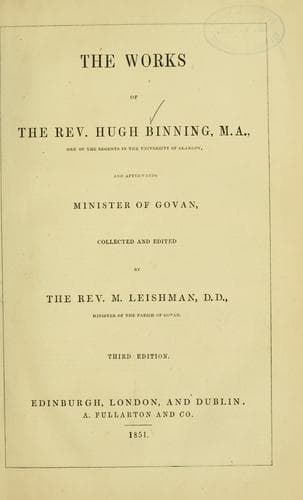
Presbyterian Church -- Sermons; Sermons, English; Theology -- Early works to 1800; Theology -- History -- 17th century
Before he was fourteen years old, he entered upon the study of philosophy
in the university of Glasgow, wherein he made very considerable progress,
and with as much facility outstripped his fellow students, as he had done
his condisciples in the Latin school, by which means, he came to be taken
notice of in the college by the professors and students. And at the same
time that he made proficiency in the liberal sciences, he advanced
remarkably in religion. The abstruse depths of philosophy, which are the
torture of slow engines and weak capacities, he dived into without any
trouble or pain. And notwithstanding his surprising attainments and
improvements, his great acumen and ready apprehension of things, whereby
he was able to do more in one hour, than others in some days by hard study
and close application, and though on these accounts he was much respected
by the eminent ministers of the city, and learned professors of the
university, yet was he ever humble, never exalted above measure, nor
swelled with the tympany of pride and self conceit, the common foible and
disease of young men of any greatness of spirit.
So soon as he had finished his course of philosophy, he was made Master of
Arts(91) with great applause, and having furnished his mind with an
uncommon measure of the ancillary knowledge of letters, he began the study
of divinity, with a view to serve God in the holy ministry. At which time
there happened to be a vacancy in the college of Glasgow, by the
resignation of Mr. James Dalrymple of Stair, who had been Mr. Binning’s
Master. This gentleman was so great and so good a man, that it is
impossible to avoid giving an account of some of the remarkable things of
his life. The first employment he had, was in the army, being a captain in
William Earl of Glencairn’s regiment of foot; but as he had made his
studies with great application, at the earnest request of the professors
of the university of Glasgow, he stood as candidate for a chair of
philosophy, in a comparative trial, (in buff and scarlet, the military
dress of those days,) to which he was with great applause preferred. In
this station he was greatly esteemed for his uncommon abilities in
philosophy, and other parts of learning. But being resolved to follow the
study of the law, he soon resigned his office of professor, and entered
Advocate upon the 7th of February, 1648; and quickly distinguished himself
by his pleadings before the Court of Session, avoiding always to take any
employment, either as advocate, or judge, in criminal matters, though
often respectively pressed to accept of both; which proceeded from a
delicacy in his opinion, lest, to wit, he might possibly be the instrument
either of making the innocent suffer, or to acquit the guilty. In this
situation he continued, till the Tender was imposed, when he, with many
other eminent lawyers, withdrew from the bar. On June 26th, 1657, he was,
by a commission signed by General Monk,(92) in name of the Protector’s
Public-domain text, read in full here on John Shaqi.
Reviews
Reviews
No reviews yet
Be the first to share your thoughts on this work.
Join the Discussion
Join the discussion
Sign in to leave a comment or review.
Sign InorCreate an account