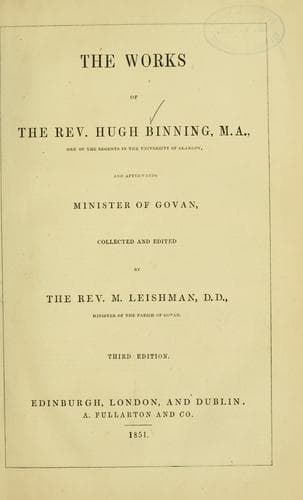
Presbyterian Church -- Sermons; Sermons, English; Theology -- Early works to 1800; Theology -- History -- 17th century
the Father’s children, and the Son’s brethren “and if children then heirs,
heirs of God,” and if brethren, then co-heirs with Christ, Rom. viii. 17.
Thus the union is begun again in Christ, but as long as sin dwells in our
mortal bodies it is not perfect, there is always some separation and some
enmity in our hearts, and so there is neither full seeing of God, for “we
know but in part,” and we see “darkly,” nor full enjoying of God, for we
are “saved by hope,” and we “live by faith, and not by sight.” But this is
begun which is the seed of eternal communion, we are here partakers of the
divine nature. Now then it must aspire unto a more perfect union with God
whose image it is. And therefore the soul of a believer is here still in
motion towards God as his element. There is here an union in affection but
not completed in fruition,—_affectu non effecta_. The soul pants after
God,—“Whom have I in heaven or earth but thee? My flesh and my heart
faileth,” &c. A believing soul looks upon God as its only
portion,—accounts nothing misery but to be separated from him, and nothing
blessedness but to be one with him. This is the loadstone of their
affections and desires, the centre which they move towards, and in which
they will rest. It is true, indeed, that oftentimes our heart and our
flesh faileth us, and we become ignorant and brutish. Our affections
cleave to the earth, and temptations with their violence turn our souls
towards another end than God. As there is nothing more easily moved and
turned wrong than the needle that is touched with the adamant, yet it
settles not in such a posture, it recovers itself and rests never till it
look towards the north, and then it is fixed—even so, temptations and the
corruptions and infirmities of our hearts disturb our spirits easily, and
wind them about from the Lord, towards any other thing, but yet we are
continuing with him, and he keeps us with his right hand, and therefore
though we may be moved, yet we shall not be greatly commoved, we may fall,
but we shall rise again. He is “the strength of our heart,” and therefore
he will turn our heart about again, and fix it upon its own portion. Our
union here consists more in his holding of us by his power, than our
taking hold of him by faith. Power and good will encamp about both faith
and the soul. “We are kept by his power through faith,” 1 Pet i. 5. And
thus he will guide the soul, and still be drawing it nearer to him, from
itself, and from sin and from the world, till he “receive us into glory,”
and until we be one as with the Father and the Son,—“He in us and we in
him, that we may be made perfect in one,” as it is in the words read.
Public-domain text, read in full here on John Shaqi.
Reviews
Reviews
No reviews yet
Be the first to share your thoughts on this work.
Elsewhere in the archive
Join the Discussion
Join the discussion
Sign in to leave a comment or review.
Sign InorCreate an account