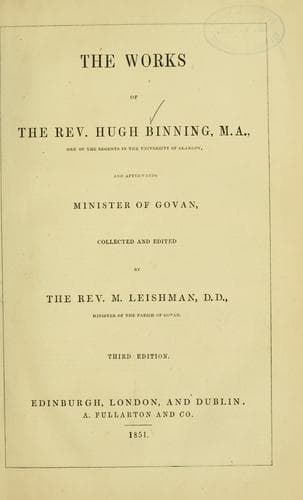
Presbyterian Church -- Sermons; Sermons, English; Theology -- Early works to 1800; Theology -- History -- 17th century
This is strange. A greater unity and fuller enjoyment, a more perfect
fellowship, than ever Adam in his innocency would have been capable of!
What soul can conceive it? what tongue express it? None can, for it is
that which “eye hath not seen, nor ear heard, neither hath it entered into
man’s heart to conceive.” We must suspend the knowledge of it till we have
experience of it. Let us now believe it, and then we shall find it. There
is a mutual inhabitation which is wonderful. Persons that dwell one _with_
another have much society and fellowship, but to dwell one _in_ another is
a strange thing,—“I in them, and they in me,” and therefore God is often
said to dwell in us, and we to dwell in him. But that which makes it of
all most wonderful and incomprehensible is that glorious unity and
communion between the Father and the Son, which it is made an emblem of.
“As thou, Father, art in me, and I in thee, that they also may be one in
us.” Can you conceive that unity of the Trinity? Can you imagine that
reciprocal inhabitation,—that mutual communion between the Father and the
Son? No, it hath not entered into the heart to conceive it. Only thus much
we know, that it is most perfect, it is most glorious, and so much we may
apprehend of this unity of the saints with God. Oh love is an uniting and
transforming thing. “God is love, and he that dwelleth in love dwelleth in
God, and God in him.” He dwelleth in us by love, this makes him work in
us, and shine upon us. Love hath drawn him down from his seat of majesty,
to visit poor cottages of sinners, Isa. lxvi. 1, 2 and xlvi. 3, 4. And it
is that love of God reflecting upon our souls that carries the soul upward
to him, to live in him, and walk with him. O how doth it constrain a soul
to “live to him,” and draw it from itself! 2 Cor. v. 15. Then the more
unity with God, the more separation from ourselves and the world, the
nearer God the farther from ourselves, and the farther from ourselves the
more happy, and the more unity with God, the more unity among ourselves,
among the brethren of our family. Because here we are not fully one with
our Father, therefore there are many differences between us and our
brethren because we are not one perfectly in him, therefore we are not
one, as he and the Father are one. But when he shall be in us, and we in
him, as the Father is in the Son and the Son in the Father, then shall we
be one among ourselves, then shall we meet in the unity of the faith, into
a perfect man, “into the measure of the stature of the fulness of Christ,”
Eph. iv. 13. Christ is the uniting principle. While the saints are not
wholly one, _uni tertio_, they cannot be perfectly one _inter se_, among
themselves. Consider this, I beseech you Christ’s union with the Father is
the foundation of our union to God, and our union among ourselves. This is
comfortable, the ground of it is laid already. Now it is not simply the
unity of the Father and the Son in essence that is here meant, for what
Public-domain text, read in full here on John Shaqi.
Reviews
Reviews
No reviews yet
Be the first to share your thoughts on this work.
Elsewhere in the archive
Join the Discussion
Join the discussion
Sign in to leave a comment or review.
Sign InorCreate an account