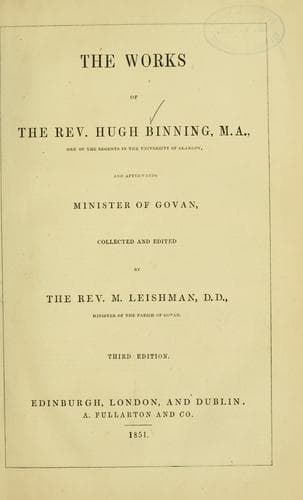
Presbyterian Church -- Sermons; Sermons, English; Theology -- Early works to 1800; Theology -- History -- 17th century
You have never yet asked in earnest, For what purpose you came into the
world? What wonder ye wander and walk at random, seeing ye have not
proposed to yourselves any certain scope and aim! It is great folly, you
would not be so foolish in any petty business, but O how foolish men are
in the main business! “The light of the body is the eye,” if that be not
light, “the whole body is full of darkness.” If your intention be once
right established, all your course will be orderly, but if you be dark and
blind in this point, and have not considered it, you cannot walk in the
light, your whole way is darkness. The right consideration of the great
end would shine unto you, and direct your way But while you have not
proposed this end unto yourselves—the enjoyment of God—you must spend your
time either in doing nothing to that purpose, or doing contrary to it.
All your other lawful business, your callings and occupations, are but in
the by; they are not the end, nor the way, but you make them your only
business; they are altogether impertinent to this end. And the rest of
your walking, in lusts and ignorance, is not only impertinent, but
inconsistent with it and contrary to it. If you think that you have this
before your eyes, to enjoy God,—I pray you look upon the way you choose.
Is your drunkenness, your swearing, your uncleanness, your contentions and
railings, and such works of the flesh,—are these the way to enjoy God?
Shall not these separate between God and you? Is your eating and drinking,
sleeping as beasts, and labouring in your callings,—are these all the
means you use to enjoy God? Be not deceived; you who draw not near God by
prayer often in secret, and by faith in his Son Christ, as lost miserable
sinners, to be saved and reconciled by him, you have no fellowship with
him, and you shall not enjoy him afterward! You whose hearts are given to
your covetousness, who have many lovers and idols besides him, you cannot
say, Whom have I besides Thee in earth? No; you have many other things
besides God. You can have nothing of God, except ye make him all to
you.—unless you have him alone. “My undefiled is One,” Cant. vi. 9. He
must be alone, for “his glory he will not give to another.” If you divide
your affections, and pretend to give him part, and your lusts another
part, you may be doing so, but he will not divide his glory so, he will
give no part of it to any other thing. But as for those souls that come to
him and see their misery without him, O know how good it is! It is not
only good, but best, yea only good; it is _bonum_, and it is _optimum_;
yea, it is _unicum_. “There is none good, save one, even God;” and there
is nothing good for us but this one, to be near God, and so near, that we
may be one,—one spirit with the Lord,—“for he that is joined to the Lord
is one spirit.” Rejoice in your portion, and long for the possession of
it. Let all your meditations and affections and conversation proclaim
Public-domain text, read in full here on John Shaqi.
Reviews
Reviews
No reviews yet
Be the first to share your thoughts on this work.
Elsewhere in the archive
Join the Discussion
Join the discussion
Sign in to leave a comment or review.
Sign InorCreate an account