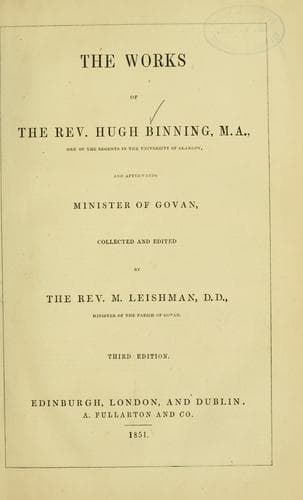
Presbyterian Church -- Sermons; Sermons, English; Theology -- Early works to 1800; Theology -- History -- 17th century
this, “Whom have I in heaven but thee? and there is none in the earth whom
I desire besides thee.” And certainly he shall guide you to the end, and
receive you into glory. Then you shall rest from your labours, because you
shall dwell in him, and enjoy that which you longed and laboured for. Let
the consideration of that end unite the hearts of Christians here. O what
an absurd thing is it, that those who shall lodge together at night, and
be made “perfect in one,” should not only go contrary ways, but have
contrary minds and affections!
Lecture III.
The Authority And Utility Of The Scriptures
2 Tim. iii. 16.—“All scripture is given by inspiration of God, and
is profitable for doctrine, for reproof, for correction, for
instruction in righteousness.”
We told you that there was nothing more necessary to know than what our
end is, and what the way is that leads to that end. We see the most part
of men walking at random,—running an uncertain race,—because they do not
propose unto themselves a certain scope to aim at, and whither to direct
their whole course. According to men’s particular inclinations and humours
so do the purposes and designs of men vary; and often do the purposes of
one man change, according to the circumstances of time and his condition
in the world. We see all men almost running cross one to another. One
drives at the satisfaction of his lust by pleasure; another fancies a
great felicity in honour; a third in getting riches; and thus men divide
themselves; whereas, if it were true happiness that all were seeking, they
would all go one way towards one end. If men be not in the right way, the
faster they seem to move toward the mark, the farther they go from it.
Wandering from the right way, (suppose men intend well) will put them
farther from that which they intend. _Si via in contrarium ducat, ipsa
velocitas majoris intervalli causa est._ Therefore it concerns us all most
deeply to be acquainted with the true path of blessedness; for if we once
mistake, the more we do, the swifter we move, the more distant we are from
it indeed. And there is the more need, because there are so many by-paths
that lead to destruction. What say I? By-paths! No; highways, beaten
paths, that the multitude of men walk in, and never challenge, nor will
endure to be challenged as if they were in an error! In other journeys,
men keep the plain highway, and are afraid of any secret by-way, lest it
lead them wrong: _At hic, via quæque tritissima maxime decipit._ Here the
high-pathed way leads wrong, and O, far wrong!—to hell. This is the
meaning of Christ’s sermon, “Enter in at the strait gate, but walk not in
the broad way where many walk, for it leads to destruction.” Therefore I
would have this persuasion once begotten in your souls, that the course of
this world,—the way of the most part of men,—is dangerous, is damnable. O
consider whither the way will lead you, before you go farther! Do not
Public-domain text, read in full here on John Shaqi.
Reviews
Reviews
No reviews yet
Be the first to share your thoughts on this work.
Elsewhere in the archive
Join the Discussion
Join the discussion
Sign in to leave a comment or review.
Sign InorCreate an account