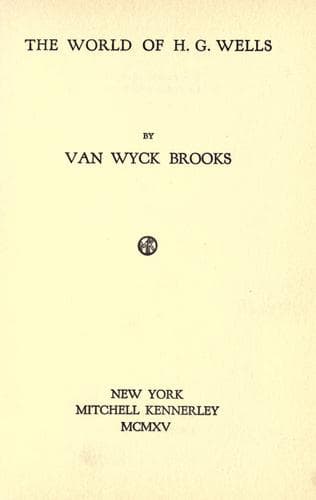
Science fiction, English -- History and criticism; Wells, H. G. (Herbert George), 1866-1946 -- Criticism and interpretation
Intensely preoccupied with contemporary ideas and inventions,
brilliantly gifted and full of life, these leaders of thought were more
innocent of literature and history than a fresh-man. Both Wells and
Bernard Shaw have confessed that throughout their most active
intellectual careers they believed instinctively that progress was
mainly a matter of chronology. To discover the future Wells considered
it necessary merely to set his imagination at work on Chicago and
multiply it by a thousand; while the famous remark of Shaw that he was
"better than Shakespeare" sprang from his assumption that, living three
centuries later, he naturally stood (as a dwarf, in his own phrase) upon
Shakespeare's shoulders. This naïveté placed them at the mercy of
literature, as they soon discovered. Everyone knows the change that came
over Bernard Shaw's cosmos when for the first time, a few years ago, he
read two or three pre-Darwinian philosophers: one could almost have
heard a pin drop when he stopped talking about being better than
Shakespeare. A similar experience, exhibited in his books, has befallen
Wells, and there is no doubt that reading has contributed to the
progressive modesty of his point of view. Each monument of historic
experience that he has absorbed has left its mark on him. Rabelais,
Machiavelli, Plato, incorporated at regular intervals in his own work,
have certainly contributed to make him less agile and less dramatic.
Let us take advantage of these post-prandial moments to survey some of
the remarkable ideas which have been added to the general stock during
this period. After the fashion of Cato, Bernard Shaw and H.G. Wells have
come late to the study of Greek. Bernard Shaw read Plato at fifty, and
in his latest book Wells has insisted that in the Great State everyone
will study Greek. Nothing could signify more plainly that these
outriders of the Modern Mind have come to a halt and wish to connect
themselves with tradition, with history, with literature, with religion,
with the grand current of human experience. Having been for so long
experimenting with new and untried forces, sharply separated from what
is received and understood, they should be related to the familiar
landmarks and connected with the main stream of English thought and
literature.
Public-domain text, read in full here on John Shaqi.
Reviews
Reviews
No reviews yet
Be the first to share your thoughts on this work.
Join the Discussion
Join the discussion
Sign in to leave a comment or review.
Sign InorCreate an account