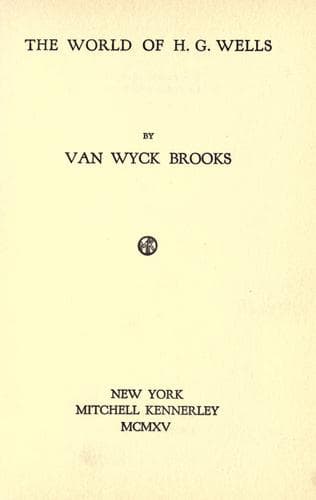
Science fiction, English -- History and criticism; Wells, H. G. (Herbert George), 1866-1946 -- Criticism and interpretation
By an original instinct the Wells hero is an inconspicuous little
person, fastidiously untheatrical, who cuts no figure personally and
who, to adopt a phrase from one of his later books, "escapes from
individuality in science and service." He abhors "personages." For the
personage is one who, in some degree, stands on his achievement, and to
Wells man, both in his love and his work, is experimental: he is an
experiment toward an impersonal synthesis, the well-being of the
species. It is true that this idea of man as an experiment does not
conflict with a very full development of personality. It consists in
that; but personality to Wells is attained purely through love and work,
and thus it comes to an end the moment it becomes static, the moment one
accepts the laurel wreath, the moment one verges on self-consequence.
The first published utterance of Wells was, I think, a paper in _The
Fortnightly Review_ for July, 1891, called _The Rediscovery of the
Unique_. It was one of the earliest of those attacks on the logical
approach to life, so characteristic of contemporary thought: it stamped
him from the outset a pragmatist. The burden of his argument was that
since the investigations of Darwin it is no longer possible to ignore
the uniqueness of every individual thing in the universe and that "we
only arrive at the idea of similar beings by an unconscious or
deliberate disregard of an infinity of small differences"--that, in
brief, the method of classification which is the soul of logic is untrue
to the facts of life. "Human reason," he wrote, "in the light of what is
being advanced, appears as a convenient organic process based on a
fundamental happy misconception.... The _reason d'être_ of a man's mind
is to avoid danger and get food--so the naturalists tell us. His
reasoning powers are about as much a truth-seeking tool as the snout of
a pig, and he may as well try to get to the bottom of things by them as
a mole might by burrowing."
I quote thus his rudely graphic early statement of the case, because he
has not since substantially modified it and because it shows that he
already related it to human realities: and indeed in the same paper he
pointed out the relation that such an idea must bear to ordinary
conduct:
Beings are unique, circumstances are unique, and therefore
we cannot think of regulating our conduct by wholesale
dicta. A strict regard for truth compels us to add that
principles are wholesale dicta: they are substitutes of more
than doubtful value for an individual study of cases.
Public-domain text, read in full here on John Shaqi.
Reviews
Reviews
No reviews yet
Be the first to share your thoughts on this work.
Join the Discussion
Join the discussion
Sign in to leave a comment or review.
Sign InorCreate an account