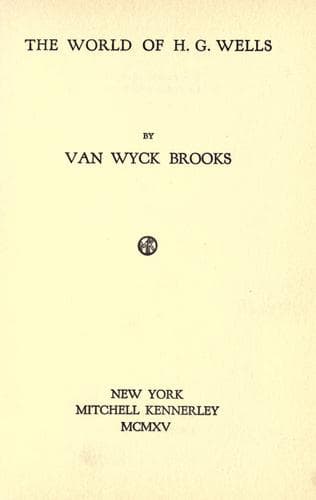
Science fiction, English -- History and criticism; Wells, H. G. (Herbert George), 1866-1946 -- Criticism and interpretation
And again later:
The race flows through us, the race is the drama and we are
the incidents. This is not any sort of poetical statement:
it is a statement of fact. In so far as we are individuals,
so far as we seek to follow merely individual ends, we are
accidental, disconnected, without significance, the sport of
chance. In so far as we realize ourselves as experiments of
the species for the species, just in so far do we escape
from the accidental and the chaotic. We are episodes in an
experience greater than ourselves.... Now none of this, if
you read me aright, makes for the suppression of one's
individual difference, but it does make for its correlation.
We have to get everything we can out of ourselves for this
very reason that we do not stand alone; we signify as parts
of a universal and immortal development. Our separate selves
are our charges, the talents of which much has to be made.
It is because we are episodical in the great synthesis of
life that we have to make the utmost of our individual lives
and traits and possibilities.
Naturally then, just as he holds by the existing State as a rudimentary
collective organ in public affairs, so also, in theory, he holds by the
existing Church. His Church of the Future bears to the existing Church
just the relation which the ultimate State of socialism bears to the
existing State. "The theory of a religion," says Wells, "may propose the
attainment of Nirvana or the propitiation of an irascible Deity or a
dozen other things as its end and aim. The practical fact is that it
draws together great multitudes of diverse individualized people in a
common solemnity and self-subordination, however vague, and is so far
like the State, and in a manner far more intimate and emotional and
fundamental than the State, a synthetic power. And in particular the
idea of the Catholic Church is charged with synthetic suggestion; it is
in many ways an idea broader and finer than the constructive idea of any
existing State."
Public-domain text, read in full here on John Shaqi.
Reviews
Reviews
No reviews yet
Be the first to share your thoughts on this work.
Join the Discussion
Join the discussion
Sign in to leave a comment or review.
Sign InorCreate an account