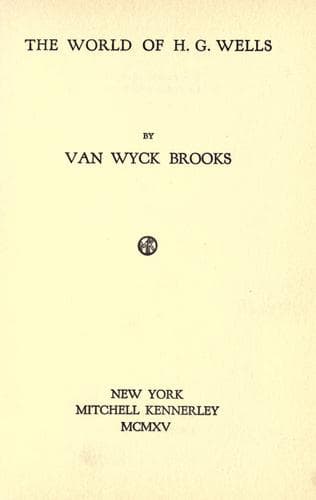
Science fiction, English -- History and criticism; Wells, H. G. (Herbert George), 1866-1946 -- Criticism and interpretation
In _Tono-Bungay_, as I have said, one sees the union of these two trains
of interest, muddled humanity being represented in Uncle Ponderevo,
constructive theory in George Ponderevo. And in all the subsequent
novels this fusion continues. The background in each case is the static
world of muddle from which Wells is always pushing off into the open sea
of possibilities, the foreground being occupied by a series of men and
women who represent this dynamic forward movement. And the philosophy of
Wells has finally come to port in human nature.
"Few modern socialists," he says somewhere, "present their faith as a
complete panacea, and most are now setting to work in earnest upon those
long-shirked preliminary problems of human interaction through which the
vital problem of a collective head and brain can alone be approached."
And elsewhere he says: "Our real perplexities are altogether
psychological. There are no valid arguments against a great-spirited
socialism but this, that people will not. Indolence, greed, meanness of
spirit, the aggressiveness of authority, and above all jealousy,
jealousy from pride and vanity, jealousy for what we esteem our
possessions, jealousy for those upon whom we have set the heavy fetters
of our love, a jealousy of criticism and association, these are the real
obstacles to those brave large reconstructions, those profitable
abnegations and brotherly feats of generosity that will yet turn human
life--of which our individual fives are but the momentary parts--into a
glad, beautiful and triumphant coöperation all round this sunlit world."
Public-domain text, read in full here on John Shaqi.
Reviews
Reviews
No reviews yet
Be the first to share your thoughts on this work.
Join the Discussion
Join the discussion
Sign in to leave a comment or review.
Sign InorCreate an account