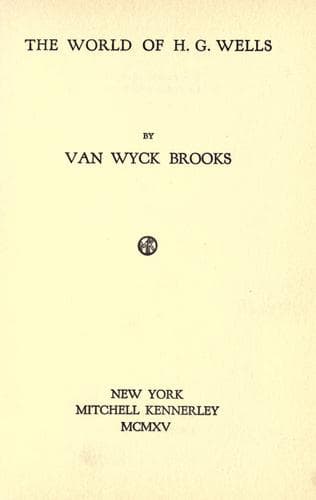
Science fiction, English -- History and criticism; Wells, H. G. (Herbert George), 1866-1946 -- Criticism and interpretation
I pause at this word. It is one of those talismanic words one finds
perpetually cropping up in the writings of men who have a marked point
of view, words that express deep and abiding preferences and often set
the key of an entire philosophy. "I like bare things," says George
Ponderevo, in _Tono-Bungay;_ "stripped things, plain, austere, and
continent things, fine lines and cold colors." That is the gesture of an
artistic mind which repudiates, with an impatient sharpness, all the
entanglements of the ordinary world. It is Oriental, it is Japanese, it
is anything you like; but if it is English also it marks an entirely new
regime. Without question it is English, and American as well. Thousands
of people share that preference, and were economic socialism to go by
the board we should still have to reckon with the progress of
socialistic human nature. It detaches itself each day a little more from
property, locality, and the hope of reward; it ceases to be
necessitarian, it becomes voluntary; it relegates drudgery to mechanical
devices; it releases the individual to a sense of his own coöperative
and contributory place in the scheme of a more orderly future.
Relatively speaking, the tendency of our kind is all away from luxury,
sloth, complacency, confusion, ignorance, filth, heat, proprietorship,
and all in the direction of light, austerity, agility, intelligence,
coolness, athletic energy, understanding, cleanliness, order, "bare
things, fine lines, and cold colors."
That is evident, and it is equally evident that the personal character
and career of Wells are emblematic of this entire tendency. He has
unravelled himself by science, talent, and vigor out of "lower middle
class" Victorianism. Is it strange that he has adopted as a kind of
sacred image that light, free, and charming product of our decade, the
aeroplane, sprung as it is out of the wreckage, out of the secret
beginnings, the confused muscularities, the effort and smoke of the most
chaotic of all centuries, like a blade of exquisitely tempered and
chased steel which justifies everything that was most laborious and
unsightly in the forge?
Public-domain text, read in full here on John Shaqi.
Reviews
Reviews
No reviews yet
Be the first to share your thoughts on this work.
Elsewhere in the archive
Join the Discussion
Join the discussion
Sign in to leave a comment or review.
Sign InorCreate an account