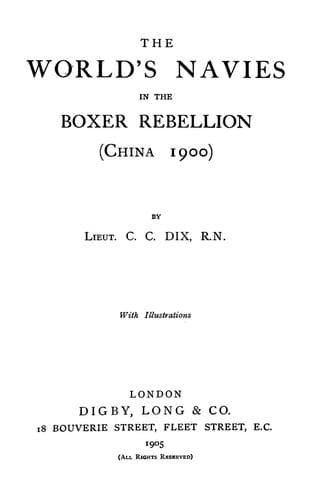
The world's navies in the Boxer rebellion (China 1900)Dix, Charles Cabry
History
The world's navies in the Boxer rebellion (China 1900)
Dix, Charles Cabry
China -- History -- Boxer Rebellion, 1899-1901
The force which left the settlement on the afternoon of August 4th,
was by many considered to be far too small for the task in front of
it; it only numbered between 16,000 and 17,000 men, and suffered
from many disadvantages common to mixed forces. There were so many
chiefs, with as many different ideas; there was a great lack of
efficient transport among some of the forces; the weather was either
scorching hot or very wet; and, finally, there were supposed to be
four times as many Chinese between Tientsin and Pekin as European
troops which had left the former place; but when everything had been
said and done, there was the same desire burning in each breast of
the 16,000, and there was a keen rivalry between the forces, which
plainly told that each would exert himself to the utmost for the
honour of his country. The start was hardly auspicious, for although
the weather was perfect when the last column left Tientsin, before
the first companies had reached Hsi-Ku arsenal, where was to be the
first night’s bivouac, the rain was coming down in torrents; and as
the men were without tents, the prospect was altogether miserable.
With the certainty of a general engagement on the morrow, the troops
did the best for themselves that they could, and lay down in the mud
near the posts which they were to occupy in the morning’s fighting.
The Chinese position lay to the direct front, at a distance of
under four miles; it was immensely strong, and had been chosen with
such care that every eventuality seemed to have been allowed for.
Unfortunately, as had already happened so often, the utter want of
good officers, and the limited amount of backbone remaining in his
troops, rendered all the skilful dispositions of the Chinese General
of no avail, and all his miles of entrenchments, the work of weeks,
useless. The Japanese lay on the right of the allied force, the
British in the centre, and the Russians on the left,—the Americans,
who were to have worked in the centre, did not turn up in time to
take any serious part in the engagement. At half-past four, the ball
was opened by the Chinese artillery, who began to fire aimlessly in
the direction of Hsi-Ku arsenal. Shortly after this, the Japanese
pushed straight to the front, and in face of some slight opposition,
stormed the outlying Chinese trenches; the enemy withdrew to their
main defences, and the battle opened with severe musketry fire from
both sides. The Japanese artillery was hard at work from the very
beginning, but the British guns had as yet taken no part. At last
the Royal Artillery came into action near the river embankment, and
as usual they did not forget their wonderful parade-ground movements
under fire; it might have been a competition, so smartly was every
action performed. They immediately came under a hot fire, and lost
a few men; and although their shooting was everything that could be
desired, the position was not a favourable one, and they soon moved
away to the left.
Public-domain text, read in full here on John Shaqi.
Reviews
Reviews
No reviews yet
Be the first to share your thoughts on this work.
Elsewhere in the archive
Join the Discussion
Join the discussion
Sign in to leave a comment or review.
Sign InorCreate an account