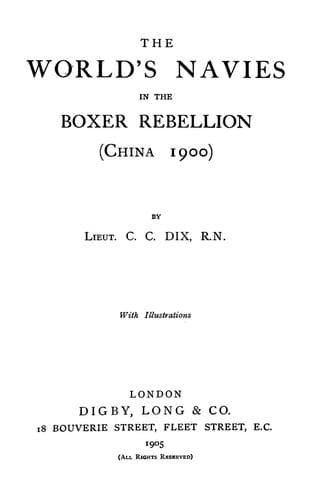
The world's navies in the Boxer rebellion (China 1900)Dix, Charles Cabry
History
The world's navies in the Boxer rebellion (China 1900)
Dix, Charles Cabry
China -- History -- Boxer Rebellion, 1899-1901
The enemy’s guns presently began to show signs of
being overmatched, and an infantry advance became possible. This the
Japanese led, and with extraordinary gallantry swept right down on
to the trenches, which were simply blazing with hostile fire, taking
the first one with the bayonet, and then waiting for reinforcements
and a short rest. The advance became general, and the Chinese guns
began to shift their positions preparatory to withdrawing, and,
at length beginning to realise that they were beaten, the infantry
became more and more unsteady, and also evinced a strong desire to
be off. Two more brilliantly executed attacks transformed their
ideas into action, and they commenced to flee. The cavalry was
immediately launched at the fugitives, and the Japanese getting
among the retreating artillery, succeeded in capturing six guns. The
Indian cavalry fared hardly so well. A change seemed to have come
over the Chinese officers, and for once they retreated with, instead
of before, their men, and managed to keep some sort of formation
and discipline among their companies. Three times the cavalry were
forced to sheer off from the compact bodies of riflemen, who seemed
to instinctively understand that foot soldiers in close order have
nothing to fear from horsemen, and time after time they turned to
their front, and received the lancers with such steadiness that it
would have been foolhardiness to press the charge right home. An
opportunity, however, at length came, and it was fully demonstrated
that broken infantry stand no chance whatever against some of the
finest horse soldiers in the world, who, no matter how long they have
been compelled to delay their attack, had proved themselves capable
of waiting for the supreme moment when cohesion is lost in the ranks
of the defeated, and a defeat becomes a rout. Even when the day was
irretrievably lost, here and there parties of the enemy offered a
stubborn resistance, doubtless with a view to the escape of their
remaining guns. The Naval guns had taken but a small part in this
important action; but although labouring under several disadvantages,
the work they did was rather surprising. For many reasons, notably
that they had to keep near the river in order to be ready for instant
embarkation, also that their chief role was meant to be that of a
Siege battery, the guns were left at a prohibitive range for the
ordinary field guns. In addition to this the enemy were not visible
to the men laying their guns; but by firing on a bearing, the range
being taken by officers up ladders and trees, they managed to create
considerable havoc among the groups of the flying enemy at the
beginning of the retreat. The Chinese fled towards Pekin, leaving a
strong body of infantry, to check pursuit, in the village of Peitsang
itself. These gave a lot of trouble, but were eventually ousted by
the Japanese, who indeed may almost lay claim to the whole credit of
Public-domain text, read in full here on John Shaqi.
Reviews
Reviews
No reviews yet
Be the first to share your thoughts on this work.
Elsewhere in the archive
Join the Discussion
Join the discussion
Sign in to leave a comment or review.
Sign InorCreate an account