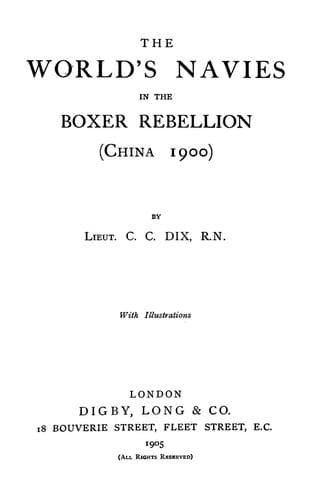
The world's navies in the Boxer rebellion (China 1900)Dix, Charles Cabry
History
The world's navies in the Boxer rebellion (China 1900)
Dix, Charles Cabry
China -- History -- Boxer Rebellion, 1899-1901
After that first success, we have seen how Tientsin settlements were
attacked by the enemy, and how, after a gallant defence, they were
relieved by the column from the forts, who had been reinforced from
Port Arthur and Hong-Kong. Immediately after—in fact, at the same
time as all this was taking place—we have followed Seymour’s march
and ultimate retirement, and the relief of Tientsin brings us to his
relief, which followed on the next day. Then comes the second siege
of Tientsin, with its extraordinary aggressive defence, during which
all outlying Chinese arsenals and positions were stormed and taken,
until at last Tientsin city alone remained. This stronghold itself
was attacked and fell, and there seemed likely to be a prolonged
rest on both sides, for it had already been proved that to advance
on Pekin with anything but an overwhelming force was useless, and it
may be confidently asserted that the Chinese would not have resumed
offensive tactics for some time, on account of extreme exhaustion—the
word being used in the sense in which it is applicable to an army,
rather than in its physical meaning. But all the operations had taken
time, and during the month that had elapsed from the commencement of
the war, troops were hurrying from Kiel, Marseilles, Spezzia, Fiume,
India, the Philippines, Japan, and Port Arthur, and a number of these
had already landed at Taku.
It became evident that the sailors’ work as infantrymen had finished,
and they once more found themselves employed as “Handymen,” mounting
two 4-in. Q.F. on field carriages, getting junks ready for the army,
unloading lighters, doing all the fatigue work—in fact, tidying
up, so that the soldiers might have a flying start. This kind of
thing represents the dregs of active service, but the men had the
satisfaction of knowing that they were going to be represented by
six guns and a battalion of marines, and they worked to such purpose
that it may be doubted whether any army corps has ever landed to find
such a perfect preparation, or their initial task in such a nearly
finished condition. As many men as could be spared went down to their
ships to recruit their health for the fortnight before the advance
was to commence, but a company were shortly recalled to Tientsin,
and received orders to construct a battery on the south face of the
settlements, to ward off a possible attack from the south-westward,
where it was reported the enemy were massing in great numbers. Work
was commenced on the night of arrival, and by the next evening, by
dint of much labour, the following guns were in position, ready for
use: seven 6-pr. Q.F., three 9-pr. M.L. field guns, three Maxims, and
a five-barrelled Nordenfelt. It might be termed a scratch pack, but
such was their position, that they were capable of holding off any
number of infantry, and might have successfully dealt with artillery
up to three thousand yards.
Public-domain text, read in full here on John Shaqi.
Reviews
Reviews
No reviews yet
Be the first to share your thoughts on this work.
Elsewhere in the archive
Join the Discussion
Join the discussion
Sign in to leave a comment or review.
Sign InorCreate an account