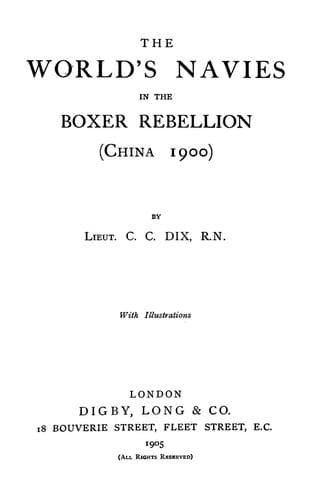
The world's navies in the Boxer rebellion (China 1900)Dix, Charles Cabry
History
The world's navies in the Boxer rebellion (China 1900)
Dix, Charles Cabry
China -- History -- Boxer Rebellion, 1899-1901
floating. Sights like this, and others yet more horrible, were only
too common, and it is not to be wondered at that the “junk parties,”
as they were called, were glad when their labours finished, and a
sufficient number had been collected.
The allied Commanders usually met every day to discuss their plans,
and to fix the probable date of starting, when an event happened
which altered all existing arrangements. A message arrived, which
again urged the necessity of the utmost despatch, or it would be too
late. This, at least, showed that things were fearfully critical
inside the Capital, and it found a responsive echo in the Commanders’
breasts, so that it was decided to leave Tientsin on August 5th,
which date was afterwards altered to the 4th.
Of course the advance had been preceded by a reconnaissance to
ascertain where the enemy intended making his first stand, to
discover his numbers, and to make him, if possible, disclose the
strength of his position. This had all been done by the Japanese on
the 21st of July, and when at last the little army moved out of the
settlement, it was felt that everything possible had been done to
ensure the success of the enterprise.
When the relief force had left, the troops in the settlement,
consisting of Japanese, Indians, and a few Americans, French, and
Russians, and a small Naval detachment, still had plenty to do;
scares began again immediately, and a new system of defence had to be
arranged. The British were busily employed in perfecting the south
battery, and all the other nations were working at similar tasks.
The lines had been greatly enlarged since the fall of the City, and
included all the space enclosed by the mud wall, which encircled
the native City as well as the settlements, and which was held by
Japanese at several points on the right bank of the river—notably at
the Taku gate and the Hi-Kuan-Su arsenal. The suburbs on the other
bank were held by the Russians, who also occupied the flanking forts
to the north-westward, as far as, and including, the Hsi-Ku arsenal.
Down at Taku the utmost activity prevailed. The 6th U.S. cavalry
disembarked and proceeded to Tientsin, but were not able to join in
the advance, owing to the condition of their horses; the Italian
Bersaglieri also landed, and shortly arrived in Tientsin. They
looked workmanlike and smart, and their rate of marching was really
astonishing.
Another thing which occupied a good deal of attention at Taku was the
completing of two 4-in. Q.F. guns on improved carriages of Captain
Percy Scott’s original design. These eventually turned up too late,
and although they were sent to the front, they were never brought
into action.
Public-domain text, read in full here on John Shaqi.
Reviews
Reviews
No reviews yet
Be the first to share your thoughts on this work.
Elsewhere in the archive
Join the Discussion
Join the discussion
Sign in to leave a comment or review.
Sign InorCreate an account