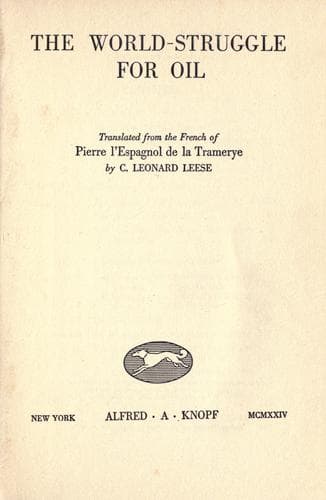
The World-Struggle for OilL'Espagnol de la Tramerye, Pierre Paul Ernest
History
The World-Struggle for Oil
L'Espagnol de la Tramerye, Pierre Paul Ernest
Petroleum; Petroleum industry and trade; War -- Economic aspects
It was not merely the oil deposits of Mesopotamia that France, in
return for a lowly and subordinate participation in British control,
was abandoning to Britain--as they would have had the Chamber believe
at the time of the noisy debate upon Mosul--but the whole of French
oil interests, present and future, whether in the colonies or abroad.
The first article of the agreement which Mr. Lloyd George and the real
"Grand Master" of British oil policy, Sir John Cadman, presented for
signature, stipulated, it is true, that "this memorandum relates to the
following States or countries: Rumania, Asia Minor, territories of the
old Russian Empire, Galicia, French Colonies," and that the agreement
might be extended to other countries by mutual consent; but, of British
territories, only "British Crown Colonies" were opened to French
co-operation, and then only "so far as existing regulations allow."
Thus, London kept an easy method of evasion in reserve. Now, though the
British Empire counts many "Dominions," there is not nowadays a large
number of "Crown Colonies." The former German Colonies themselves, with
one exception, have been handed over to the Commonwealth of Australia,
or to New Zealand, or to the Union of South Africa. Thus, apart from
former German East Africa and a small strip of the Cameroons which
France ceded to Nigeria, these will not be open to "Franco-British
co-operation."
There is but a single country in which the San Remo Agreement has
provided equal treatment for France and Britain, at least in theory;
that country is Rumania.
Rumania is the State in which French interests were the most important;
they would be increased still more by the spoils of the _Deutsche Bank_
and the _Disconto-Gesellschaft_. Accordingly, the two Governments
pledged themselves to support each other in acquiring concessions
which belonged to sequestrated companies, such as the _Steaua Romana_,
_Concordia_, and _Vega_, and in obtaining fresh concessions. "All
shares belonging to former enemy concessions which can be secured and
all other advantages derived from these negotiations shall be divided,
50 per cent. to British interests and 50 per cent. to French interests.
It is understood that in the company or companies to be formed to
undertake the management and the exploitation of the said shares,
concessions, and other advantages, the two countries shall have the
same proportion of 50 per cent. in all capital subscribed, as well as
in representatives on the board, and voting power."
This equality was not a favour, for the French capital invested in
Rumanian oil was at least as important as that of Britain.
Public-domain text, read in full here on John Shaqi.
Reviews
Reviews
No reviews yet
Be the first to share your thoughts on this work.
Elsewhere in the archive
Join the Discussion
Join the discussion
Sign in to leave a comment or review.
Sign InorCreate an account