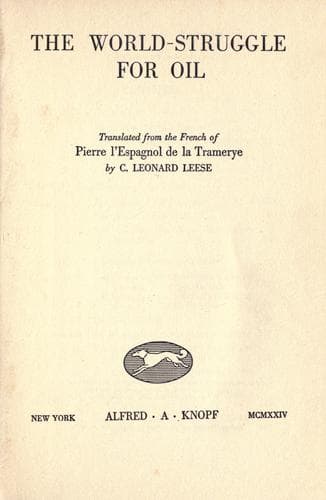
The World-Struggle for OilL'Espagnol de la Tramerye, Pierre Paul Ernest
History
The World-Struggle for Oil
L'Espagnol de la Tramerye, Pierre Paul Ernest
Petroleum; Petroleum industry and trade; War -- Economic aspects
In the territories of the old Russian Empire, where French interests
are much less important than British interests, an equal distribution
is not provided for: it would have been to the advantage of France.
But it is stated that the two Governments will give their "joint
support" to those of their nationals who make "joint efforts" to
obtain concessions, and to export and deliver oil. Now, at the present
moment, such efforts are being made by the _Royal Dutch-Shell_
alone, which is even going to the length of proposing to the Soviet
Government to restore the oil industry of Russia, if it is granted
extra-territoriality for its concessions.
In Mesopotamia, "the British Government undertake to grant to the
French Government 25 per cent. of the net output" if the Mesopotamian
oil-fields are developed by Government action. If a private company is
used, the British Government will place at the disposal of the French
Government a share of 25 per cent. in such company. Thus, in the one
case France will be simply a consumer of oil, or in the other she will
be both a producer and a consumer. The negotiators took care to have
inserted that "the price to be paid for such participation shall be no
more than that paid by any of the other participants." They remembered
the price at which British coal had been sold them!
"It is also understood that the said petroleum company shall be _under
permanent British control_." Should a private company be constituted,
"the native Government or other native interests shall be allowed, if
they so desire, to participate up to a maximum of 20 per cent. of the
share capital of the said company, the French contributing one-half of
the first 10 per cent. of such native participation." With this system,
as M. Delaisi has observed, France would subscribe a _third_ of the
capital, upon which condition she would have a right to a _quarter_ of
the oil produced.
If Britain consented to give France this share of the Mesopotamian oil,
when, according to the document which Sir Edward Grey had got M. Paul
Cambon to sign on May 15, 1915, she was _under no obligation_ to give
anything at all--the more so because France had given up Mosul without
previously laying down any conditions about the oil[51]--it was because
the present carried with it as a counterpart privileges and exemptions
granted by France to the _Anglo-Persian_, which will have access, if it
so desires, to the Mediterranean by pipe-lines across Syria. It will
even be able to build railways, refineries, and reservoirs there, and
France is pledged to guarantee the security of its installations in her
zone without levying any tolls. No export or transit dues are to be
levied upon the oil which it sends through French ports.
Public-domain text, read in full here on John Shaqi.
Reviews
Reviews
No reviews yet
Be the first to share your thoughts on this work.
Elsewhere in the archive
Join the Discussion
Join the discussion
Sign in to leave a comment or review.
Sign InorCreate an account