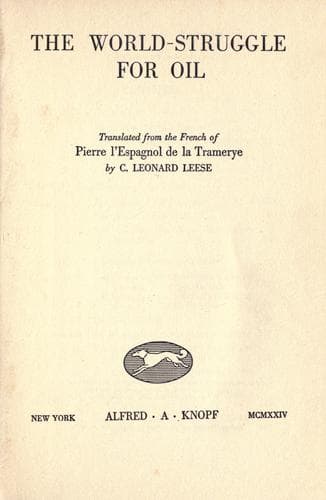
The World-Struggle for OilL'Espagnol de la Tramerye, Pierre Paul Ernest
History
The World-Struggle for Oil
L'Espagnol de la Tramerye, Pierre Paul Ernest
Petroleum; Petroleum industry and trade; War -- Economic aspects
Finally, while the British Government only opens its "Crown Colonies"
to French penetration, and in these restricts the favour to the
"territories of the Crown,"[52] with the further condition that the
concessions in question are not already the subject of negotiations
initiated by private interests, the French Government threw open the
whole of its great colonial empire, and undertook to facilitate the
acquisition of concessions by "any Franco-British group or groups of
good standing." It simply called attention to the fact that Parliament
had resolved that, in companies formed for the exploitation of colonial
deposits, French interests should be represented in the proportion
of 67 per cent. But the French Parliament was under an illusion: in
order to have control of a business, it is not sufficient to hold
one-half or three-quarters of the shares. Every one knows that, in
France, shareholders rarely attend the general meetings which appoint
the directors. Still less will they undertake the journey to London,
where the head office will almost always be located. They do not
even go to The Hague; this explains why they have no influence in the
_Royal Dutch_, although they hold more than half its capital. The last
increase of capital of the _Royal Dutch_ was voted by _forty-four
persons_, representing 218 votes. People did not allow their private
arrangements to be disturbed by an event which might have notable
results upon the world-future of this trust: not one share in 1,110 was
represented.
However, Britain did not wait till the San Remo Agreement was signed
before grasping the oil-fields of the French colonial empire: she
gained possession of them while the War was being fought!
FOOTNOTES:
[Footnote 45: These facts are still too recent and too controversial
for me to be able to make any more detailed reference to them.]
[Footnote 46: Agreement signed in London, October 27, 1920. Cp. chap.
xi, _A State-subsidized Company (the Anglo-Persian)_.]
[Footnote 47: Policy of the "Auxiliary Greek Empire."]
[Footnote 48: _Revue Universelle_, October 15, 1920, Le Page,
_L'Impérialisme du Pétrole_.]
[Footnote 49: The _Standard Oil_ obtained the grant of seven
concessions there, to the south of the Dead Sea, which the British are
preventing it from exploiting.]
[Footnote 50: If he knew of it, there can never have been so serious a
diplomatic blunder.]
[Footnote 51: One of two things should have been done: either Mosul
should only have been given up against the promise of a large share
of its production, or Upper Mesopotamia should have been retained,
because, even if its deposits had been exploited by British companies,
the presence of France would have forced them to reckon with her.]
[Footnote 52: This phrase does not appear in the official English text
of the San Remo Agreement.--Translator's Note.]
CHAPTER XX
GREAT BRITAIN AND THE OIL-FIELDS OF THE FRENCH COLONIAL EMPIRE
Public-domain text, read in full here on John Shaqi.
Reviews
Reviews
No reviews yet
Be the first to share your thoughts on this work.
Elsewhere in the archive
Join the Discussion
Join the discussion
Sign in to leave a comment or review.
Sign InorCreate an account