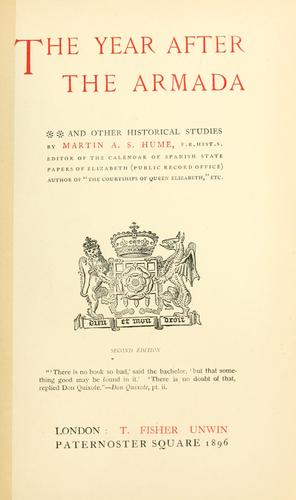
The Year after the Armada, and Other Historical StudiesHume, Martin A. S. (Martin Andrew Sharp)
Philosophy
The Year after the Armada, and Other Historical Studies
Hume, Martin A. S. (Martin Andrew Sharp)
Armada, 1588; Europe -- History -- 1517-1648; Europe -- History -- 17th century
and banishing him for ever from all the dominions of his Catholic
Majesty. The Grand Inquisitor naturally chose the former, and resigned
next morning. Pressure was put on Pope Urban VIII. by the Spanish
Ambassador, and very shortly an order arrived from Rome that the whole
of the documents and evidence in the case were to be sealed up and sent
in a box by a messenger of the Holy Office to his Holiness himself for
decision. The messenger chosen was one of the Inquisition notaries
called Alfonso Paredes. The Count-Duke, under various pretexts,
delayed this man's departure for some weeks, and in the meanwhile had
good portraits of him painted and sent by special messengers to all the
ports in Italy where he was likely to land, and orders were sent to the
Spanish agents to capture him at all risks. On the night of his
arrival at Genoa, by the connivance of the authorities, he was seized,
gagged, and carried off to Naples, where he was imprisoned for the rest
of his life, condemned to perpetual silence on pain of instant death.
The box of papers that he bore was sent privately to the King, who,
with Olivares, burnt the contents without even opening the packet. The
new Grand Inquisitor, who was a creature of the Queen, a Benedictine
monk named Diego de Arce, was not to be entirely balked, and although
no evidence now existed, he had the prothonotary Don Geronimo
Villanueva brought from his prison in Toledo, where he had languished
for two years, and placed before the tribunal of the Inquisition. He
was stripped of his arms, accoutrements, insignia of rank and outer
clothing, and sat upon a plain low wooden stool, and then, without any
evidence being given or statement of specific offence, was condemned
for irreligion, sacrilege, superstition, and other enormities, and, by
the mercy of the Holy Office, was absolved from all this on condition
that he fasted every Friday for a year, never again entered the
convent, and gave 2,000 ducats to the poor through the monks of Atocha.
{343}
_THE JOURNAL OF RICHARD BERE._
{345}
[Illustration: Headpiece]
_THE JOURNAL OF RICHARD BERE._[1]
Public-domain text, read in full here on John Shaqi.
Reviews
Reviews
No reviews yet
Be the first to share your thoughts on this work.
Elsewhere in the archive
Join the Discussion
Join the discussion
Sign in to leave a comment or review.
Sign InorCreate an account