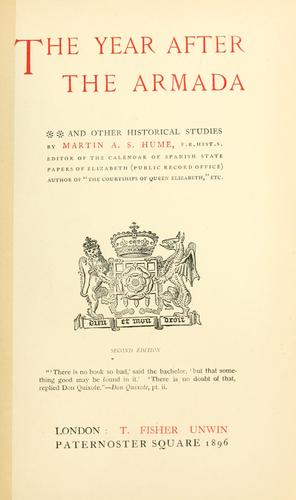
The Year after the Armada, and Other Historical StudiesHume, Martin A. S. (Martin Andrew Sharp)
Philosophy
The Year after the Armada, and Other Historical Studies
Hume, Martin A. S. (Martin Andrew Sharp)
Armada, 1588; Europe -- History -- 1517-1648; Europe -- History -- 17th century
In the course of a recent search amongst the Sloane MSS. at the British
Museum for a document of an entirely different character I chanced upon
a manuscript which, so far as I have been able to discover, has never
yet been described in print or received the attention it appears to
deserve. It is a long, narrow book like an account book, in the Sloane
binding, containing 244 pages of cramped and crowded little writing in
faded ink on rough paper, recording the daily--almost hourly--movements
of a man for eleven years, from the 1st of January, 1692-3, to the
middle of April, 1704. It is written in Spanish--Englishman's Spanish,
full of solecisms and English idioms, but fair and fluent Castilian for
all that, and the diarist, thinking no doubt his secrets were safe in a
language comparatively little known at the time, has set down for his
own satisfaction alone, and often in words that no amount of editing
would render fit for publication, the daily life of one of the
dissolute men about town, who roistered and ruffled in the
coffee-houses and taverns of London at the end of the seventeenth
century. Few men could hope to possess the keen {346} observation and
diverting style of Samuel Pepys, or the sober judgment and foresight of
stately John Evelyn, and this last contemporary diarist of theirs
certainly cannot lay claim to any such qualities. He rarely records an
impression or an opinion, and as a rule confines himself to a bald
statement of his own movements and the people he meets day by day; but
still, even such as it is, the diary is full of quaint and curious
suggestions of the intimate life of a London widely different from
ours. The familiar names of the streets, nay, the very signs of the
taverns, are the same now as then, but in every line of the fading
brown ink may be gathered hints of the vast chasm that separates the
busy crowded life of to-day from the loitering deliberation with which
these beaux in swords and high-piled periwigs sauntered through their
tavern-haunting existence. It strikes the imagination, too, to think
that the man who thus sets down so coarsely and frankly the acts of his
life must have listened, with however little appreciation, to the
luminous talk of wondrous John Dryden at Will's coffee-house, most
certainly knew the rising Mr. Addison, and probably met Matthew Prior
at his old home at the "Rummer" tavern, which the diarist frequented.
There is nothing in the manuscript directly to identify the writer, and
probably the indirect clues furnished by references to his relatives
have never before been followed up to prove exactly who the author was.
The task has not been an easy one, and has started me on more than one
false scent ending in a check, but at last I stumbled on evidence that
not only absolutely identified the {347} diarist, but also explained
many obscure passages in the manuscript.
Public-domain text, read in full here on John Shaqi.
Reviews
Reviews
No reviews yet
Be the first to share your thoughts on this work.
Elsewhere in the archive
Join the Discussion
Join the discussion
Sign in to leave a comment or review.
Sign InorCreate an account