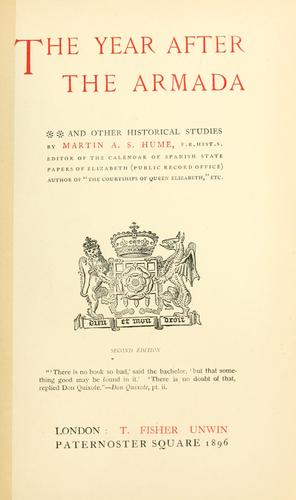
The Year after the Armada, and Other Historical StudiesHume, Martin A. S. (Martin Andrew Sharp)
Philosophy
The Year after the Armada, and Other Historical Studies
Hume, Martin A. S. (Martin Andrew Sharp)
Armada, 1588; Europe -- History -- 1517-1648; Europe -- History -- 17th century
On the 28th of April "the fleet entered the Downs, the wind blowing a
gale at the time. A ship called the _Windsor_ was lost. I went to
Deal to see the ships, and saw five ensigns." Small details of
ablutions--rare enough they seem nowadays--bed-warming, and quaint
remedies for trifling ailments sound queerly enough to us coming
faintly across the gloom of two centuries, but in the midst of the
chronicles of this small beer of visits paid and received, of the
stomach-ache, and so on, brother John receives a writ, and we feel that
we are witnesses of the process by which all this feasting {352} and
revelry is completing the ruin of the ancient family that once owned
broad lands and far manors all over Kent, which founded hospitals and
colleges, and was closely allied to the regal Plantagenets, but whose
possessions had even now shrunken to one poor mansion house of Danes
Court and the few farms around it. John Fogge's father, Richard, whose
pompous Latin epitaph is still in Tilmanston Church, written by his
eldest son, Edward, and scoffed at in the family Bible by the
degenerate John, had been true to the King's side during the civil war.
His near neighbour, Sir John Boys of Betshanger, had hunted and harried
the cavalier and sacked his house after the mad Kentish rising in 1648,
and had frightened his favourite child to death, and for the whole of
the Commonwealth period poor Richard had been plundered and well-nigh
ruined. His sons Edward and John had been captured at sea by the
Dutch, and Christopher had been taken prisoner by the Turks, and all
three had had to be bought off with ransom. Stout old Richard Fogge
therefore had left Danes Court sadly embarrassed at his death in 1680.
His eldest son, Edward, died soon after, and John Fogge, the
brother-in-law of our diarist, was rapidly continuing the ruin at the
date of the diary. By the 30th of May Richard Bere had had enough of
Danes Court, and started to Canterbury "with my brother's horse and
servant, and so to Northfleet, where I visited my kinsman Childs." He
mounted his horse at five o'clock in the morning and arrived at
Northfleet at five in the evening, staying on the way only a short time
at Canterbury to rest and drink with friend Best, at whose house he
always alights when {353} he passes through the ancient city. The
distance by road is a good fifty-five miles, so Richard no doubt
thought he had earned his night's rest at Uncle Childs' before
starting, as he did next day, by tilboat to London. The first thing he
did when he arrived was to "drink with Higgs" and send for Benson to
meet him at Phillips' mug-house. Benson appears to have been a humble
friend or foster-brother, as Bere calls Benson's father "my father
Benson," who went on all his errands, pawned his valuables, and faced
his creditors. When Benson came they started out together and took a
room, where they both slept, "at the sign of the 'Crown,' an inn in
Public-domain text, read in full here on John Shaqi.
Reviews
Reviews
No reviews yet
Be the first to share your thoughts on this work.
Elsewhere in the archive
Join the Discussion
Join the discussion
Sign in to leave a comment or review.
Sign InorCreate an account