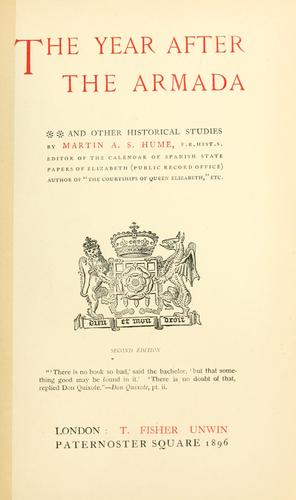
The Year after the Armada, and Other Historical StudiesHume, Martin A. S. (Martin Andrew Sharp)
Philosophy
The Year after the Armada, and Other Historical Studies
Hume, Martin A. S. (Martin Andrew Sharp)
Armada, 1588; Europe -- History -- 1517-1648; Europe -- History -- 17th century
The diary commences on the 1st of January, 1692-3, when Bere was living
at Mr. Downe's in {350} London, but the detailed entries begin on the
9th of the month, when he went by tilboat from Billingsgate to
Gravesend. Here, after visiting his aunt Bere and his kinsman Childs
at Northfleet, he slept at the inn, and started the next morning in a
coach to Canterbury. The next day he continued his journey to Danes
Court on a hired mare, and then after a few days rest, "without seeing
anybody," begins a round of visits and carouses with the neighbouring
gentry. All the squires and their families for miles round march
through the pages of the diary. Mr. Paramour, of Stratenborough; Mr.
Boys, of Betshanger, "my uncle Boys," who was probably Christopher
Boys, of Updowne, uncle by marriage to John Fogge; "my uncle Pewry,"
who was rector of Knowlton, but whose relationship with the diarist is
not clearly discoverable; Mr. Burville, rector of the Fogge Church of
Tilmanston, and a host of other neighbours come and go, dine and drink,
often staying the night, and in a day or two entertain John Fogge and
his brother-in-law in return. The latter records the fact, but
unfortunately does no more, and little is gathered of the manner of
their lives at this period of the diary, except that they did a
prodigious deal of visiting and dining at each others' houses. One of
the most constant visitors to Danes Court is the aged Lady Monins, of
Waldershare Park, the widow of the last baronet of the name, and
Richard Bere appears to be as often her guest at Waldershare. The
round of dining and visiting is broken in upon by a visit on horseback
with brother John Fogge to the assizes at Maidstone, where the latter
has a lawsuit which he loses, and Richard returns to {351} Danes Court
alone, leaving his defeated brother at Canterbury. On the 12th of
April the diarist records that he first saw the swallows, and on the
20th, as instancing the uneventful life in this remote part of the
country, it is considered worth while to register the fact that "whilst
I was digging in the garden with Carlton a man passed on horseback." A
few days afterwards neighbour Carlton's daughter is married, and then
"my nephew Richard was first sent to school at Sandwich, Timothy Thomas
being master." Richard, the heir of Danes Court, was about twelve
years old at the time, and, as we shall see later on, turned out badly
and completed the ruin of the fine old family, of which he was the last
male representative in the direct line. Timothy Thomas, who was a
distinguished scholar and M.A. of Sidney-Sussex College, Cambridge, was
headmaster of the Sandwich Free School and brother to the rector of St.
Paul and St. Mary, Sandwich. He seems to have been always ready for a
carouse at the hostelry of the "Three Kings" at Sandwich or elsewhere
with the father or uncle of his pupil.
Public-domain text, read in full here on John Shaqi.
Reviews
Reviews
No reviews yet
Be the first to share your thoughts on this work.
Elsewhere in the archive
Join the Discussion
Join the discussion
Sign in to leave a comment or review.
Sign InorCreate an account