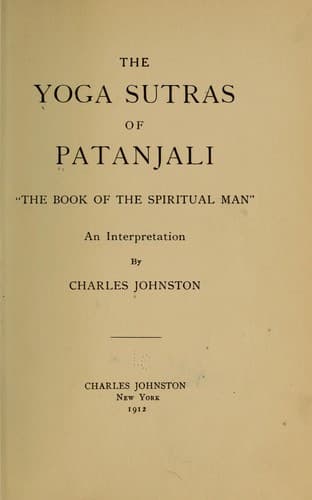
The Yoga Sutras of Patanjali: The Book of the Spiritual ManPatañjali
Religion
The Yoga Sutras of Patanjali: The Book of the Spiritual Man
Patañjali
Yoga -- Early works to 1800
THE YOGA SUTRAS OF PATANJALI
“The Book of the Spiritual Man”
An Interpretation By
Charles Johnston
Bengal Civil Service, Retired;
Indian Civil Service, Sanskrit Prizeman;
Dublin University, Sanskrit Prizeman
Contents
INTRODUCTION TO BOOK I
BOOK I
INTRODUCTION TO BOOK II
BOOK II
INTRODUCTION TO BOOK III
BOOK III
INTRODUCTION TO BOOK IV
BOOK IV
INTRODUCTION TO BOOK I
The Yoga Sutras of Patanjali are in themselves exceedingly brief, less
than ten pages of large type in the original. Yet they contain the
essence of practical wisdom, set forth in admirable order and detail.
The theme, if the present interpreter be right, is the great
regeneration, the birth of the spiritual from the psychical man: the
same theme which Paul so wisely and eloquently set forth in writing to
his disciples in Corinth, the theme of all mystics in all lands.
We think of ourselves as living a purely physical life, in these
material bodies of ours. In reality, we have gone far indeed from pure
physical life; for ages, our life has been psychical, we have been
centred and immersed in the psychic nature. Some of the schools of
India say that the psychic nature is, as it were, a looking-glass,
wherein are mirrored the things seen by the physical eyes, and heard by
the physical ears. But this is a magic mirror; the images remain, and
take a certain life of their own. Thus within the psychic realm of our
life there grows up an imaged world wherein we dwell; a world of the
images of things seen and heard, and therefore a world of memories; a
world also of hopes and desires, of fears and regrets. Mental life
grows up among these images, built on a measuring and comparing, on the
massing of images together into general ideas; on the abstraction of
new notions and images from these; till a new world is built up within,
full of desires and hates, ambition, envy, longing, speculation,
curiosity, self-will, self-interest.
The teaching of the East is, that all these are true powers overlaid by
false desires; that though in manifestation psychical, they are in
essence spiritual; that the psychical man is the veil and prophecy of
the spiritual man.
The purpose of life, therefore, is the realizing of that prophecy; the
unveiling of the immortal man; the birth of the spiritual from the
psychical, whereby we enter our divine inheritance and come to inhabit
Eternity. This is, indeed, salvation, the purpose of all true religion,
in all times.
Patanjali has in mind the spiritual man, to be born from the psychical.
His purpose is, to set in order the practical means for the unveiling
and regeneration, and to indicate the fruit, the glory and the power,
of that new birth.
Public-domain text, read in full here on John Shaqi.
Reviews
Reviews
No reviews yet
Be the first to share your thoughts on this work.
Join the Discussion
Join the discussion
Sign in to leave a comment or review.
Sign InorCreate an account