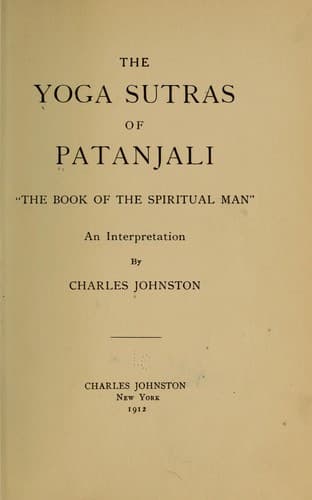
The Yoga Sutras of Patanjali: The Book of the Spiritual Man — John Shaqi
The Yoga Sutras of Patanjali: The Book of the Spiritual ManPatañjali
Religion
The Yoga Sutras of Patanjali: The Book of the Spiritual Man
Patañjali
Yoga -- Early works to 1800
4. The darkness of unwisdom is the field of the others. These
hindrances may be dormant, or worn thin, or suspended, or expanded.
Here we have really two Sutras in one. The first has been explained
already: in the darkness of unwisdom grow the parasites, hate, lust,
attachment. They are all outgrowths of the self-absorption of the
psychical self.
Next, we are told that these barriers may be either dormant, or
suspended, or expanded, or worn thin. Faults which are dormant will be
brought out through the pressure of life, or through the pressure of
strong aspiration. Thus expanded, they must be fought and conquered,
or, as Patanjali quaintly says, they must be worn thin,-as a veil
might, or the links of manacles.
5 The darkness of ignorance is: holding that which is unenduring,
impure, full of pain, not the Soul, to be eternal, pure, full of joy,
the Soul.
This we have really considered already. The psychic man is unenduring,
impure, full of pain, not the Soul, not the real Self. The spiritual
man is enduring, pure, full of joy, the real Self. The darkness of
unwisdom is, therefore, the self-absorption of the psychical, personal
man, to the exclusion of the spiritual man. It is the belief, carried
into action, that the personal man is the real man, the man for whom we
should toil, for whom we should build, for whom we should live. This is
that psychical man of whom it is said: he that soweth to the flesh,
shall of the flesh reap corruption.
6. Self-assertion comes from thinking of the Seer and the instrument of
vision as forming one self.
This is the fundamental idea of the Sankhya philosophy, of which the
Yoga is avowedly the practical side. To translate this into our terms,
we may say that the Seer is the spiritual man; the instrument of vision
is the psychical man, through which the spiritual man gains experience
of the outer world. But we turn the servant into the master. We
attribute to the psychical man, the personal self, a reality which
really belongs to the spiritual man alone; and so, thinking of the
quality of the spiritual man as belonging to the psychical, we merge
the spiritual man in the psychical; or, as the text says, we think of
the two as forming one self.
7. Lust is the resting in the sense of enjoyment.
This has been explained again and again. Sensation, as, for example,
the sense of taste, is meant to be the guide to action; in this case,
the choice of wholesome food, and the avoidance of poisonous and
hurtful things. But if we rest in the sense of taste, as a pleasure in
itself; rest, that is, in the psychical side of taste, we fall into
gluttony, and live to eat, instead of eating to live. So with the other
great organic power, the power of reproduction. This lust comes into
being, through resting in the sensation, and looking for pleasure from
that.
8. Hate is the resting in the sense of pain.
Public-domain text, read in full here on John Shaqi.
Reviews
Reviews
No reviews yet
Be the first to share your thoughts on this work.
Join the Discussion
Join the discussion
Sign in to leave a comment or review.
Sign InorCreate an account