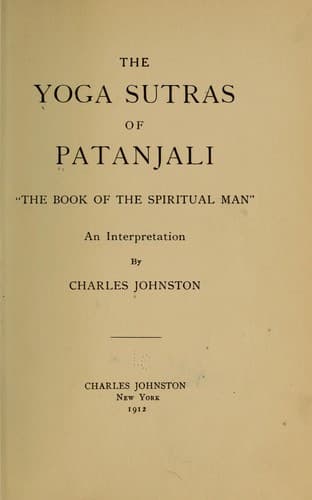
The Yoga Sutras of Patanjali: The Book of the Spiritual Man — John Shaqi
The Yoga Sutras of Patanjali: The Book of the Spiritual ManPatañjali
Religion
The Yoga Sutras of Patanjali: The Book of the Spiritual Man
Patañjali
Yoga -- Early works to 1800
Fully to comment on this, would be to write a treatise on Karma and its
practical working in detail, whereby the place and time of the next
birth, its content and duration, are determined; and to do this the
present commentator is in no wise fitted. But this much is clearly
understood: that, through a kind of spiritual gravitation, the
incarnating self is drawn to a home and life-circle which will give it
scope and discipline; and its need of discipline is clearly conditioned
by its character, its standing, its accomplishment.
14. These bear fruits of rejoicing, or of affliction, as they are
sprung from holy or unholy works.
Since holiness is obedience to divine law, to the law of divine
harmony, and obedience to harmony strengthens that harmony in the soul,
which is the one true joy, therefore joy comes of holiness: comes,
indeed, in no other way. And as unholiness is disobedience, and
therefore discord, therefore unholiness makes for pain; and this
two-fold law is true, whether the cause take effect in this, or in a
yet unmanifested birth.
15. To him who possesses discernment, all personal life is misery,
because it ever waxes and wanes, is ever afflicted with restlessness,
makes ever new dynamic impresses in the mind; and because all its
activities war with each other.
The whole life of the psychic self is misery, because it ever waxes and
wanes; because birth brings inevitable death; because there is no
expectation without its shadow, fear. The life of the psychic self is
misery, because it is afflicted with restlessness; so that he who has
much, finds not satisfaction, but rather the whetted hunger for more.
The fire is not quenched by pouring oil on it; so desire is not
quenched by the satisfaction of desire. Again, the life of the psychic
self is misery, because it makes ever new dynamic impresses in the
mind; because a desire satisfied is but the seed from which springs the
desire to find like satisfaction again. The appetite comes in eating,
as the proverb says, and grows by what it feeds on. And the psychic
self, torn with conflicting desires, is ever the house divided against
itself, which must surely fall.
16. This pain is to be warded off, before it has come.
In other words, we cannot cure the pains of life by laying on them any
balm. We must cut the root, absorption in the psychical self. So it is
said, there is no cure for the misery of longing, but to fix the heart
upon the eternal.
17. The cause of what is to be warded off, is the absorption of the
Seer in things seen.
Here again we have the fundamental idea of the Sankhya, which is the
intellectual counterpart of the Yoga system. The cause of what is to be
warded off, the root of misery, is the absorption of consciousness in
the psychical man and the things which beguile the psychical man. The
cure is liberation.
Public-domain text, read in full here on John Shaqi.
Reviews
Reviews
No reviews yet
Be the first to share your thoughts on this work.
Join the Discussion
Join the discussion
Sign in to leave a comment or review.
Sign InorCreate an account