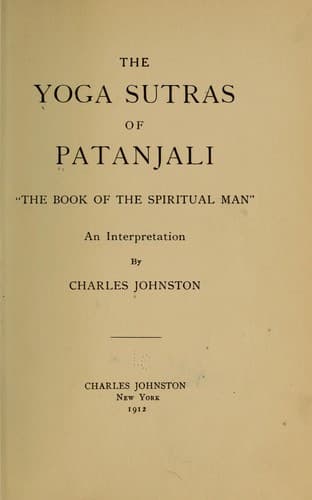
The Yoga Sutras of Patanjali: The Book of the Spiritual Man — John Shaqi
The Yoga Sutras of Patanjali: The Book of the Spiritual ManPatañjali
Religion
The Yoga Sutras of Patanjali: The Book of the Spiritual Man
Patañjali
Yoga -- Early works to 1800
When one of us conquers hate, hate does not thereby cease out of the
world, since others still hate and suffer hatred. So with other
delusions, which hold us in bondage to material things, and through
which we look at all material things. When the coloured veil of
illusion is gone, the world which we saw through it is also gone, for
now we see life as it is, in the white radiance of eternity. But for
others the coloured veil remains, and therefore the world thus coloured
by it remains for them, and will remain till they, too, conquer
delusion.
23. The association of the Seer with things seen is the cause of the
realizing of the nature of things seen, and also of the realizing of
the nature of the Seer.
Life is educative. All life’s infinite variety is for discipline, for
the development of the soul. So passing through many lives, the Soul
learns the secrets of the world, the august laws that are written in
the form of the snow-crystal or the majestic order of the stars. Yet
all these laws are but reflections, but projections outward, of the
laws of the soul; therefore in learning these, the soul learns to know
itself. All life is but the mirror wherein the Soul learns to know its
own face.
24. The cause of this association is the darkness of unwisdom.
The darkness of unwisdom is the absorption of consciousness in the
personal life, and in the things seen by the personal life. This is the
fall, through which comes experience, the learning of the lessons of
life. When they are learned, the day of redemption is at hand.
25. The bringing of this association to an end, by bringing the
darkness of unwisdom to an end, is the great liberation; this is the
Seer’s attainment of his own pure being.
When the spiritual man has, through the psychical, learned all life’s
lessons, the time has come for him to put off the veil and disguise of
the psychical and to stand revealed a King, in the house of the Father.
So shall he enter into his kingdom, and go no more out.
26. A discerning which is carried on without wavering is the means of
liberation.
Here we come close to the pure Vedanta, with its discernment between
the eternal and the temporal. St. Paul, following after Philo and
Plato, lays down the same fundamental principle: the things seen are
temporal, the things unseen are eternal.
Patanjali means something more than an intellectual assent, though this
too is vital. He has in view a constant discriminating in act as well
as thought; of the two ways which present themselves for every deed or
choice, always to choose the higher way, that which makes for the
things eternal: honesty rather than roguery, courage and not cowardice,
the things of another rather than one’s own, sacrifice and not
indulgence. This true discernment, carried out constantly, makes for
liberation.
27. His illuminations is sevenfold, rising In successive stages.
Public-domain text, read in full here on John Shaqi.
Reviews
Reviews
No reviews yet
Be the first to share your thoughts on this work.
Join the Discussion
Join the discussion
Sign in to leave a comment or review.
Sign InorCreate an account