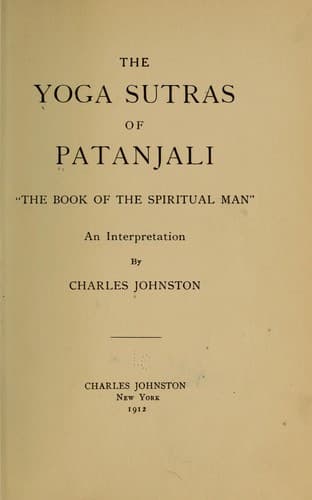
The Yoga Sutras of Patanjali: The Book of the Spiritual ManPatañjali
Religion
The Yoga Sutras of Patanjali: The Book of the Spiritual Man
Patañjali
Yoga -- Early works to 1800
This broad, general training, which forms and develops human character,
must be accomplished to a very considerable degree, before there can be
much hope of success in the further stages of spiritual life. First the
psychical, and then the spiritual. First the man, then the angel. On
this broad, humane and wise foundation does the system of Patanjali
rest.
31. The Commandments, not limited to any race, place, time or occasion,
universal, are the great obligation.
The Commandments form the broad general training of humanity. Each one
of them rests on a universal, spiritual law. Each one of them expresses
an attribute or aspect of the Self, the Eternal; when we violate one of
the Commandments, we set ourselves against the law and being of the
Eternal, thereby bringing ourselves to inevitable con fusion. So the
first steps in spiritual life must be taken by bringing ourselves into
voluntary obedience to these spiritual laws and thus making ourselves
partakers of the spiritual powers, the being of the Eternal Like the
law of gravity, the need of air to breathe, these great laws know no
exceptions They are in force in all lands, throughout al times, for all
mankind.
32. The Rules are these: purity, serenity fervent aspiration, spiritual
reading, and per feet obedience to the Master.
Here we have a finer law, one which humanity as a whole is less ready
for, less fit to obey. Yet we can see that these Rules are the same in
essence as the Commandments, but on a higher, more spiritual plane. The
Commandments may be obeyed in outer acts and abstinences; the Rules
demand obedience of the heart and spirit, a far more awakened and more
positive consciousness. The Rules are the spiritual counterpart of the
Commandments, and they have finer degrees, for more advanced spiritual
growth.
33. When transgressions hinder, the weight of the imagination should be
thrown’ on the opposite side.
Let us take a simple case, that of a thief, a habitual criminal, who
has drifted into stealing in childhood, before the moral consciousness
has awakened. We may imprison such a thief, and deprive him of all
possibility of further theft, or of using the divine gift of will. Or
we may recognize his disadvantages, and help him gradually to build up
possessions which express his will, and draw forth his self-respect. If
we imagine that, after he has built well, and his possessions have
become dear to him, he himself is robbed, then we can see how he would
come vividly to realize the essence of theft and of honesty, and would
cleave to honest dealings with firm conviction. In some such way does
the great Law teach us. Our sorrows and losses teach us the pain of the
sorrow and loss we inflict on others, and so we cease to inflict them.
Public-domain text, read in full here on John Shaqi.
Reviews
Reviews
No reviews yet
Be the first to share your thoughts on this work.
Join the Discussion
Join the discussion
Sign in to leave a comment or review.
Sign InorCreate an account